A typical detector’s 0.9 microcuries, the figure ATSDR gives, works out to only about a quarter of a microgram of americium-241 (33,000 becquerels divided by roughly 127 billion becquerels per gram). CDC lists its half-life as 432.2 years, so after 10 years, when the alarm is due for replacement, the source has lost only about 1.6 percent of its activity.
Anatomy: what's inside
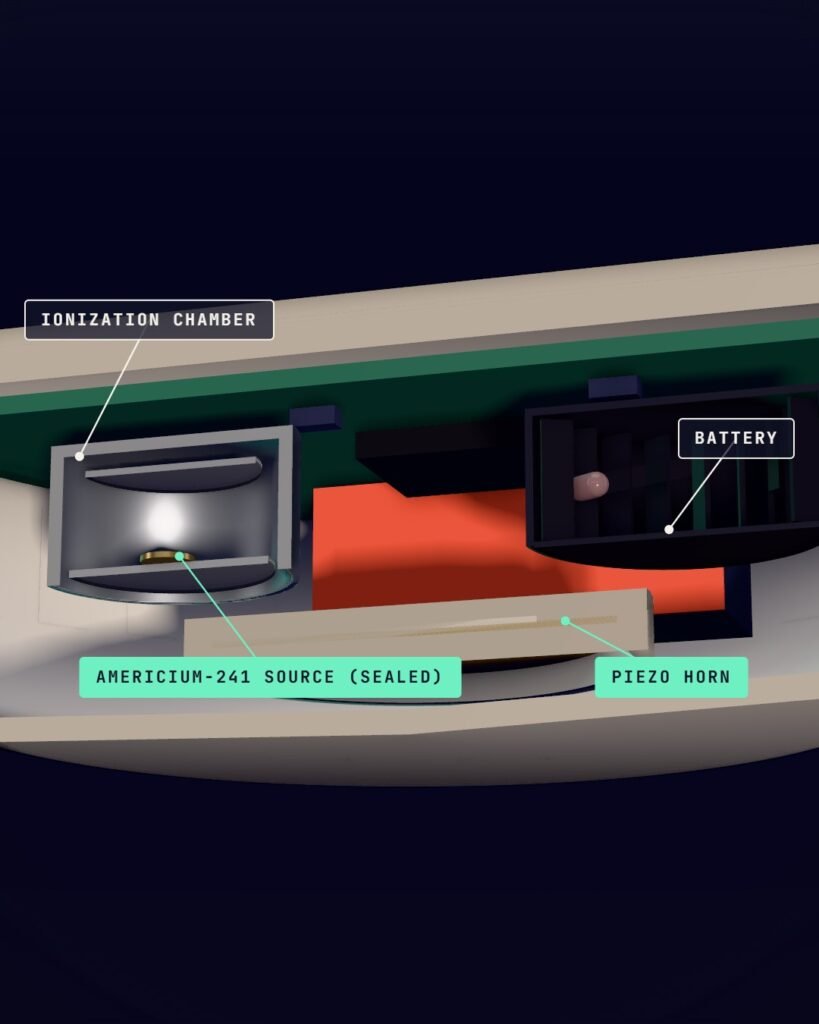
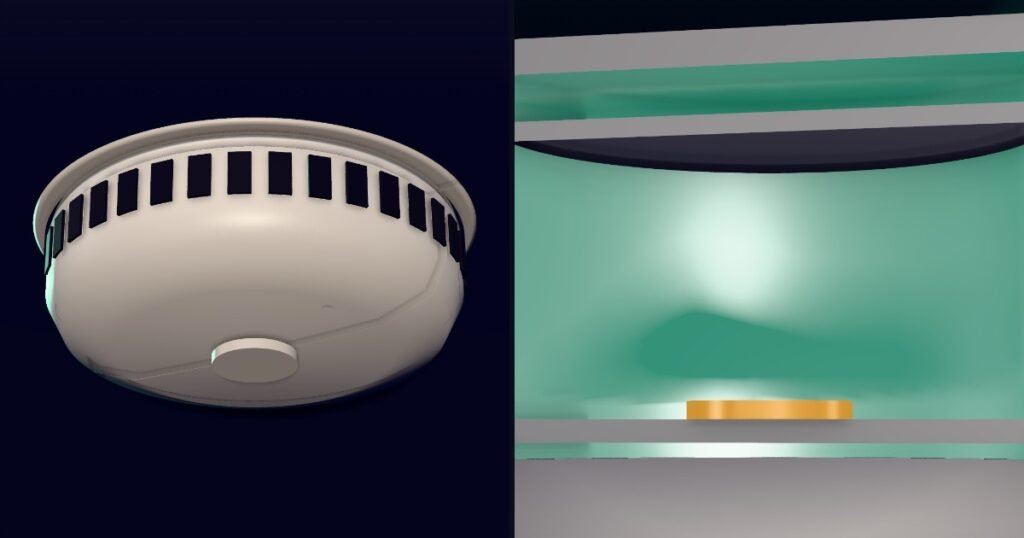
Housing and vents
The round case on your ceiling or wall. Openings in it let smoke drift in to the sensing chamber.
Ionization chamber
In ionization alarms, a small chamber with two charged plates. Ionized air lets a tiny, steady current flow between them until smoke gets in.
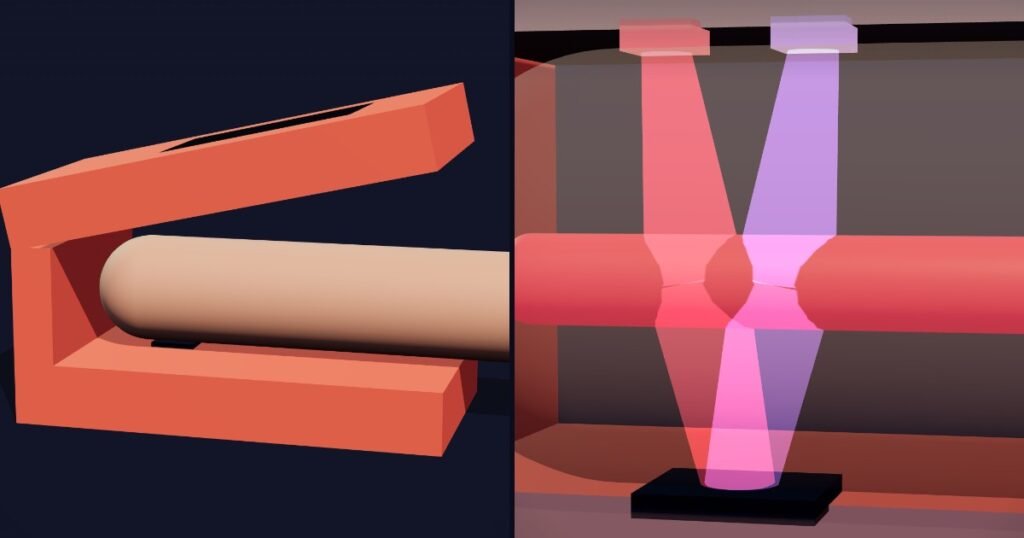
Americium-241 source
A thin foil of americium sealed in a metal holder about the size of a pencil eraser. Its alpha particles ionize the air in the chamber.
Optical sensing chamber
In photoelectric alarms, the chamber that holds the light beam and the light detector. Smoke can drift in; in clean air, the beam misses the detector.
Infrared LED
Fires short pulses of infrared light across the dark chamber, aimed so that in clean air the light misses the sensor.
Component: LEDPhotodiode
The light sensor. When smoke scatters the LED’s light onto it, the small current it produces rises.
Component: SensorControl chip
Measures the chamber and compares the reading with a stored limit (some chips re-check before alarming), then drives the horn and any interconnected alarms.
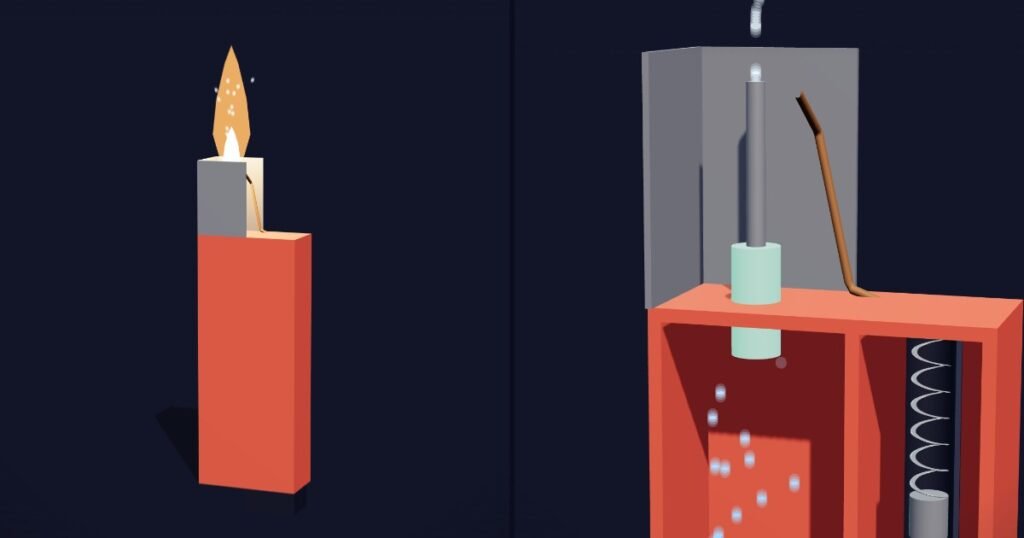
Piezo horn
A thin piezoelectric disc that flexes when voltage is applied, sounding a loud tone in a three-beep pattern without using much power.
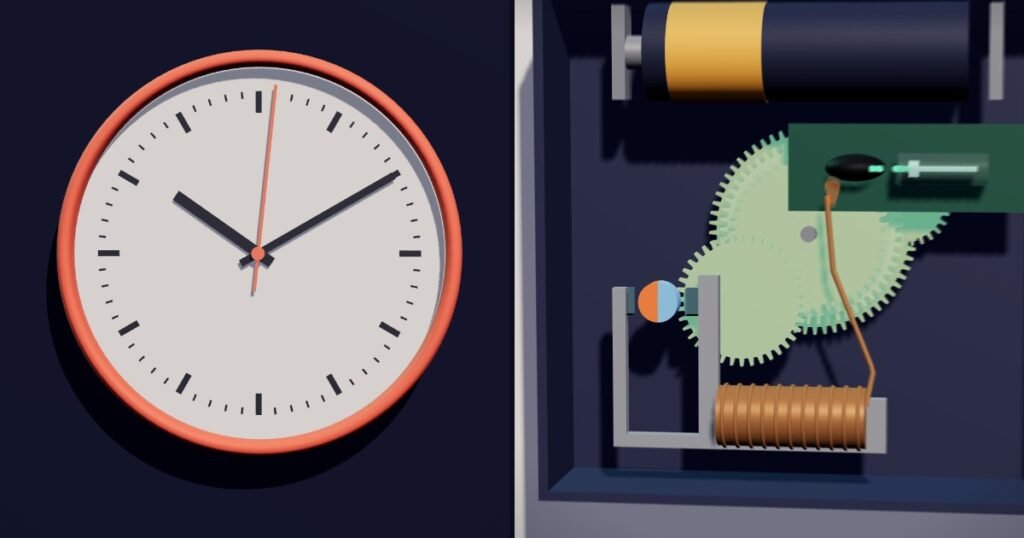
Battery
Powers the alarm, or backs up a hardwired one. Some alarms use a replaceable 9-volt battery, others a sealed 10-year battery.
Component: BatteryA smoke alarm doesn’t smell anything
A smoke alarm has no nose. It doesn’t sense flames or the smell of something burning. What it notices is particles: the tiny bits of soot, ash and droplets that smoke is made of. Once enough of them drift inside, the horn sounds.
There are many brands, but the National Fire Protection Association (NFPA) says they fall under two basic types: ionization and photoelectric. One watches a tiny electric current flowing through air. The other watches for light bouncing where it shouldn’t. Some alarms carry both sensors in one case.
Inside an ionization alarm: a current through air
Ordinary air conducts electricity very poorly. An ionization alarm changes that inside one small chamber. As the U.S. Nuclear Regulatory Commission (NRC) explains, it uses radiation from a small amount of americium-241 to ionize the air. Most units sold today use one microcurie or less. A 2004 public health statement from CDC’s Agency for Toxic Substances and Disease Registry (ATSDR) puts a typical household detector at 0.9 microcuries.
The americium isn’t a loose speck of powder. NRC says the source is sandwiched between two layers of metal and rolled thin, and this “foil” is sealed inside the chamber. The EPA describes it as encased in foil and ceramic, and CDC says it sits inside a metal cylinder about the size of a pencil eraser.
Americium-241 gives off alpha particles. They knock electrons off air molecules, leaving behind charged ions. Two charged metal plates pull the ions toward them, and NIST describes the result as a small electric current flowing from one plate to the other through the air.
What smoke does to the current
Smoke particles are enormous compared with an ion. When they drift in, NIST says, they attract the ions and carry them away, so the current drops. It doesn’t have to stop completely. The circuit only needs to see it fall past a set level.
- Alpha particles ionize the air. The sealed source keeps knocking electrons off air molecules in the chamber.
- The plates collect the ions. A tiny, steady current flows across the gap.
- Smoke gets in. Its particles grab ions and carry them off.
- The current falls. Once it drops past the set point, the circuit switches on the horn.
Is the americium safe?
While it stays sealed, yes. The EPA says the shielding stops the alpha particles from leaving the detector, so it poses no radiation health risk when properly handled. NRC adds that alpha particles only travel a few inches and are a health hazard only if taken into the body. Americium-241 also gives off weak gamma radiation, CDC notes, but NIST says the levels are much lower than the natural background radiation around you every day.
A 2001 NRC study found that people with two of these units at home receive less than 0.002 millirems of radiation dose a year. Homeowners need no license to use them; manufacturers do.
The picture changes if the source is broken out. CDC says americium-241 powder that is swallowed, inhaled or absorbed through a wound can stay in the body for decades. NRC says the seal can only be broken by deliberate force, and discourages it. The EPA’s advice: never tamper with an ionization alarm or try to remove the americium.
Inside a photoelectric alarm: light that misses on purpose
A photoelectric alarm has no radioactive source. Its sensing chamber holds a light beam and a light detector. NIST explains the trick: in clean air, the beam does not strike the detector. Smoke particles reflect some of the light onto it, and once the light it registers reaches a threshold, the alarm sounds.
Microchip’s RE46C190, an older photoelectric smoke detector chip, drives an infrared emitter and detector pair. To save battery, it wakes every 10 seconds and fires an infrared pulse of 100 to 400 microseconds, then compares the photodiode’s current with a limit stored at calibration. Its test button switches to high gain, so faint background reflections in the chamber stand in for smoke.
- The infrared LED pulses. In clean air, its light misses the sensor.
- Smoke enters the chamber. Particles scatter some light sideways.
- The photodiode catches it. The small current it produces rises past the limit.
- The chip double-checks. In Microchip’s design, it checks more often, and three detections in a row start the horn.
Flaming fires, smoldering fires, and why you want both
According to NIST, ionization alarms tend to detect the small black soot particles from flaming fires more quickly, while photoelectric alarms are more sensitive to larger particles. NFPA puts it simply: ionization alarms are more responsive to flaming fires, photoelectric alarms to smoldering ones. NIST stresses that both kinds can detect either.
In NIST’s home smoke alarm study, which ran real-scale fire tests in two homes, either type consistently gave occupants time to escape most fires, though sometimes not much. Ionization alarms responded somewhat better to flaming fires; photoelectric alarms often responded considerably faster to smoldering ones.
You can’t choose your fire, so the U.S. Fire Administration (USFA) recommends both ionization and photoelectric alarms, or dual-sensor alarms. UL’s Fire Safety Research Institute says fire is faster today because of synthetic materials in furnishings and building materials and more open floor plans. The 8th edition of UL 217, the smoke alarm safety standard, aims to help alarms better detect flaming and smoldering fires, particularly those involving polyurethane foam. NIST says it went into effect as of June 30, 2024.
The burnt-toast problem
An alarm that cries wolf gets disabled. The NIST study cites a CPSC survey in which about half of respondents reported nuisance alarms, 80 percent of them from cooking. NIST’s own tests found ionization alarms tended to go off from aerosols released early in some cooking, before smoke was noticeable.
UL 217 now tests for this. In its cooking nuisance test, alarms sit 10 feet from an electric range while frozen hamburger patties broil, and must not go off before the smoke reaches a set level. NFPA says new multi-criteria alarms state “helps reduce cooking nuisance alarms” on the packaging.
NFPA also advises keeping alarms at least 10 feet (3 meters) from the stove, and calls photoelectric alarms the best type near kitchens and bathrooms. If one goes off while you cook, USFA says never take the battery out. Open a window, press the hush button, wave a towel, or move the alarm several feet farther away.
The horn, and making sure you hear it
Most alarms sound through a piezoelectric horn, a thin disc that flexes when voltage is applied. CPSC staff note piezo horns can be loud without using much power, and typical alarm horns sound at 3,000 to 4,000 Hz. NFPA says a repeating set of three loud beeps means smoke or fire.
UL 217 has required at least 85 dBA measured 10 feet from the horn, under set test conditions. That is no longer the only figure. UL Standards & Engagement says a 2021 revision lowered the minimum for low-frequency alarms to 79 dBA at 10 feet, instead of 85 dBA, and cites research showing low-frequency alarms wake people who are hard of hearing more effectively.
Loud at the alarm isn’t loud at your pillow. In CPSC staff tests, closing a lightweight door cut an alarm’s sound by 10 to 20 dBA. A basement alarm heard through a door on the second floor measured around 30 dBA, which would most likely not wake an unimpaired adult. That is why USFA advises interconnected alarms: when one sounds, they all sound.
Keeping your alarms working
NFPA says roughly three out of five home fire deaths happen in homes with no smoke alarms or no working ones.
- Cover every sleeping area. NFPA and USFA advise alarms inside each bedroom, outside each sleeping area, and on every level, including the basement.
- Mount them high. On the ceiling or high on a wall, following the manufacturer’s instructions.
- Test at least monthly, and as your manual says. Press the test button and listen for the beeps.
- Know your battery. USFA says to replace 9-volt batteries, and backup batteries in hardwired alarms, at least once a year. Alarms with a sealed 10-year battery are replaced whole, as the manufacturer instructs.
- Replace every alarm at 10 years. NFPA counts from the manufacturing date, not the day you bought it.
- Learn the chirp. NFPA says a single chirp every 30 or 60 seconds means a low battery; chirping after a fresh battery means the alarm’s life is over.
- Plan for hearing loss. NFPA lists strobe-light alarms and pillow or bed shakers for people who are deaf or hard of hearing.
How it works, step by step
Smoke drifts in
Particles from a fire float up to the ceiling and slip through the vents into the alarm’s sensing chamber.
Ionization: the current drops
In an ionization alarm, smoke particles grab the ions that carry the tiny current between the two plates, so the current falls.
Photoelectric: light scatters
In a photoelectric alarm, smoke particles scatter the LED’s light onto a photodiode that clean air keeps in the dark.
The chip checks
The control chip compares the reading with a stored limit. In some designs, such as Microchip’s RE46C190, it checks again, faster, before sounding the alarm.
The horn sounds
The chip drives the piezo horn in the three-beep emergency pattern. Interconnected alarms in other rooms sound too.
Myth vs fact
A smoke alarm reacts to heat or to the smell of burning.
It reacts to particles. An ionization alarm notices them through a drop in a tiny current; a photoelectric alarm notices light they scatter onto a sensor.
The americium in an ionization alarm makes it dangerous to keep at home.
Sealed and intact, it poses no radiation health risk, says the EPA. NRC found people with two of these alarms receive less than 0.002 millirems a year. The risk comes from breaking the source out, so never open one.
Each type of alarm can only detect one kind of fire.
NIST says both types can detect both flaming and smoldering fires. The difference is speed, which is why USFA recommends both types or dual-sensor alarms.
Taking the battery out is a fine fix for an alarm that goes off when you cook.
USFA says never take the battery out. Press the hush button, open a window, wave a towel to clear the air, or move the alarm farther from the kitchen.
Test every smoke alarm at least monthly, and as often as its manual says, and replace the whole alarm 10 years after its manufacturing date. Never take out the battery or disable an alarm because of cooking: press the hush button, fan the air or move the alarm farther from the kitchen. Never open or tamper with an ionization alarm: EPA says this could damage the shielding around its americium source. Dispose of old alarms according to the manufacturer’s instructions and your local rules.
Questions people ask
How do I know if my smoke alarm is ionization or photoelectric?
Check the label on the back of the alarm, the packaging or the manual, which usually name the sensing type. Dual-sensor alarms contain both kinds of sensor.
How often should I test and replace my smoke alarms?
NFPA and USFA say to test them at least once a month; follow your manual if it asks for more. Replace the whole alarm 10 years after its manufacturing date.
Why does my smoke alarm chirp?
NFPA says a single chirp every 30 or 60 seconds means the battery is low. If it keeps chirping after you fit a fresh battery, the alarm has reached the end of its life and needs replacing.
Why does my smoke alarm go off when I cook?
Cooking releases particles too, and NIST found ionization alarms can react to them early. Keep alarms at least 10 feet from the stove, use photoelectric alarms near the kitchen, and look for alarms labeled as reducing cooking nuisance alarms.
How do I get rid of an old ionization smoke alarm?
Follow the manufacturer’s instructions and your local rules. The EPA says there are no special disposal instructions: they may go in household garbage, or your community may run a recycling program. ATSDR (2004) advises returning damaged detectors, or ones no longer in use, to the manufacturer. Never take one apart.
Sources
Published by Cut It Open. Checked against every listed source before publishing.
Facts last verified 2026-11-15
Published November 19, 2026 · Updated November 15, 2026