The crystal in a lighter works on an effect discovered in 1880 by Pierre and Jacques Curie. They named it piezoelectricity, from piezein, the Greek word for “squeeze”.
Anatomy: what's inside
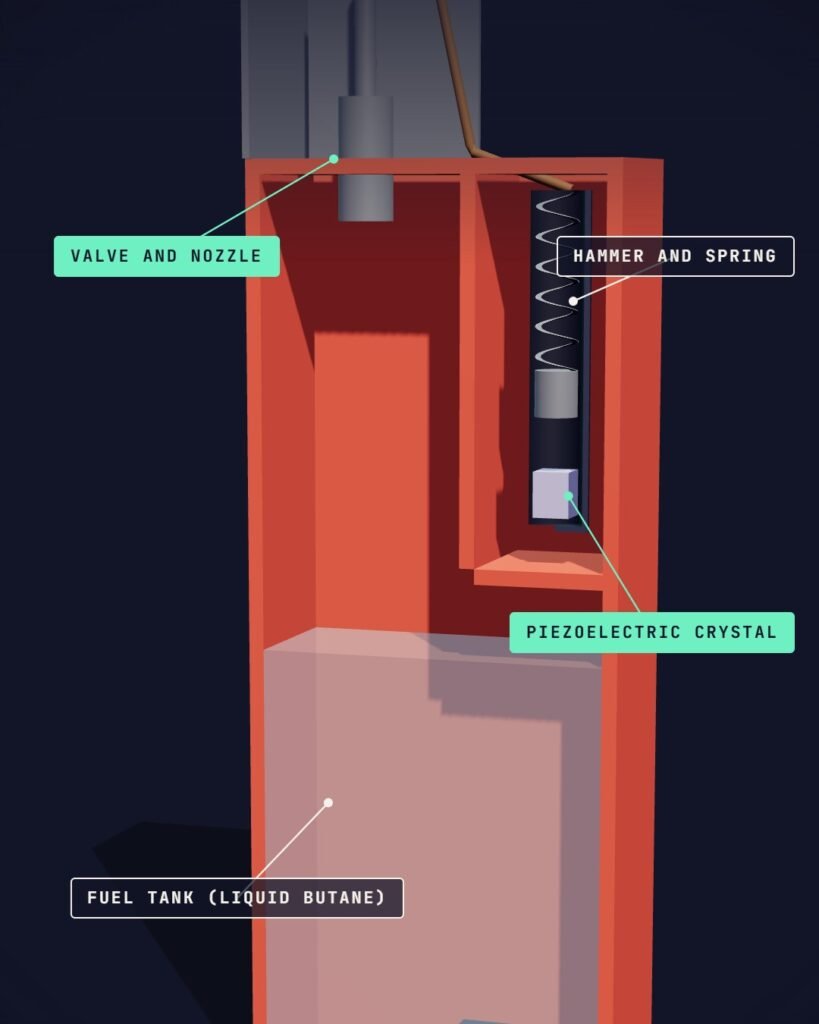
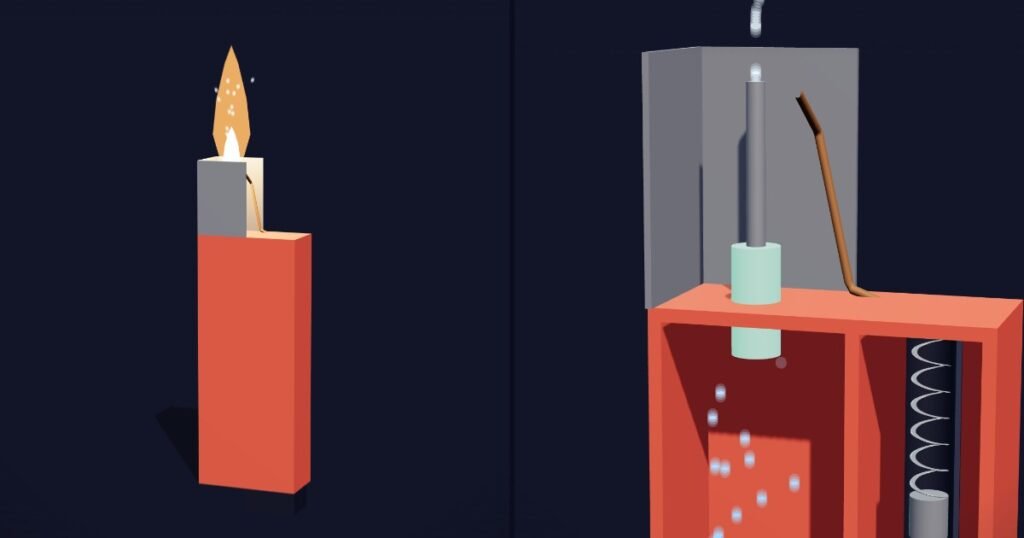
Fuel tank
Holds butane as a liquid, kept from boiling by the pressure of its own vapor above it.
Valve and nozzle
Opens when you press the button and lets a stream of butane gas out of the nozzle.
Component: ValvePush button
One press both opens the valve and works the igniter. In some designs the flame stays lit only while you hold it.
Hammer and impact spring
The spring is squeezed as you press. At the end of the stroke the hammer is released and the spring throws it against the crystal.
Component: SpringPiezoelectric crystal
Turns the sudden blow from the hammer into a burst of high voltage. It may be a ceramic such as PZT rather than a natural crystal.
Component: Piezo igniterElectrodes and spark gap
Two contacts a short distance apart. The voltage jumps the gap as a spark, right where the gas stream passes.
Child-resistant mechanism
Required on disposable, novelty and multi-purpose lighters sold in the US, so that most children under 5 can’t operate the lighter.
Fire from one press of a button
Press the button on a gas lighter and a flame appears. There is no match to strike, and on a push-button lighter there is often no battery either. All of the energy for the spark comes from your thumb.
Two things happen in that one press. A valve lets fuel out of the tank, and a tiny hammer hits a crystal that turns the blow into a spark. This article follows both, using the patents that describe these lighters and the physics behind them. It covers the push-button piezo lighter. Flint-wheel lighters and battery-powered lighters make their spark in other ways.
The tank: a liquid that wants to be a gas
The fuel is usually butane. A Ronson lighter patent from 1973 describes the reservoir as holding “a fuel such as liquid butane”. That is the first clever part: the fuel is stored as a liquid, which packs far more of it into a small tank than a gas would.
Butane only stays liquid because it is sealed in. According to the NIST Chemistry WebBook, n-butane boils at about 273 kelvin, which is roughly 0°C (32°F), at normal air pressure. At room temperature it would rather be a gas. Inside the closed tank, some of it evaporates until the pressure of that vapor stops the rest from boiling. Calculated from NIST’s vapor-pressure data, that pressure is about 2.4 bar at 25°C, roughly two and a half times the pressure of the air around you.
So the tank holds liquid butane with a cushion of butane vapor above it, pushing on every wall. The fuel is ready to rush out the moment it gets a way out.
Press the button: a valve lets the gas out
Pressing the button opens a valve in the fuel tank. In the Ronson design, depressing the fingerpiece opens a burner valve so that “a stream of gas” escapes. Once the butane leaves the tank, nothing holds it at tank pressure any more, so the liquid boils into gas and streams out of the nozzle, where it mixes with air.
The same press also works the igniter. A 1985 patent for a foldable safety lighter spells it out: its push button is “arranged to actuate both piezoelectric crystal 25 and movable valve 15 for the fuel supply simultaneously”, and the flame stays lit only while the button is held. Let go, and the valve closes.
The spark: a hammer and a crystal
Inside the igniter is a small spring-loaded hammer. A Swedish piezoelectric gas lighter patent from 1974 describes the trick: the spring-loaded hammer is carried by the push button and is “loaded and released when the push button is fully pressed in”. As you press, a spring is squeezed. At the end of the stroke the hammer slips free and the spring throws it against the crystal.
That sudden blow matters. Ronson’s piezoelectric ignition patent notes that a higher voltage can be produced by applying an impact rather than a steady squeeze. The crystal is wired to an electrode, with a second electrode a short distance away, and the voltage is high enough that a spark jumps the gap between them. The same patent reports that one impact can produce a series of sparks, because the crystal and its mounting ring like a struck bell and give several voltage peaks.
This is also why the button has a definite point where it gives. The hammer only fires once the spring is fully loaded, so the strength of the blow does not depend on how fast you press.
Why squeezing a crystal makes electricity
The crystal is piezoelectric: squeeze it and electric charge appears on its faces. According to the American Physical Society, Pierre and Jacques Curie discovered the effect in 1880. They tested materials including quartz, topaz, cane sugar, Rochelle salt and tourmaline, and found the strongest effects in quartz and Rochelle salt. The name comes from piezein, Greek for “squeeze”.
The effect also works in reverse: put a voltage across the crystal and it changes shape. The APS notes that Gabriel Lippmann predicted this converse effect and the Curies confirmed it. The same physics runs quartz watches, microphones and inkjet printers. In a lighter it is used the simple way round: a mechanical blow in, a burst of high voltage out.
The part need not be a natural crystal. The Swedish patent speaks of “a piezoelectric crystal or element”, and piezo maker APC International makes its standard igniter elements from PZT, a lead zirconate titanate ceramic, for ovens, grills, water heaters and other gas appliances.
Gas meets spark
For the lighter to work, the spark has to happen in the right place at the right time. The designs are arranged so that the gas stream passes the electrode gap just as the hammer strikes. In the Ronson lighter, the impact of the hammer on its anvil “creates an ignition spark across the electrodes”, and “a stream of gas from a burner valve” is “directed across the spark and is ignited”.
One press, in order:
- Press. Your thumb starts to open the valve and squeezes the spring behind the hammer.
- Release. Butane leaves the tank, boils into gas and mixes with air at the nozzle.
- Strike. At the end of the stroke the hammer slips free and hits the crystal.
- Spark. The voltage jumps the electrode gap, right in the gas stream.
- Burn. The flame burns the gas still flowing. In designs like the 1985 patent’s, letting go closes the valve.
Once lit, the flame keeps itself going, so the igniter has done its job after a fraction of a second.
Flint, piezo and battery lighters
Many lighters still make their spark the older way, with a rough wheel scraping a flint. The Ronson patent points out the catch with flints: “a supply of flints must be maintained to replenish exhausted flints.” A piezo igniter has no flint to wear out, and it needs no battery, because the energy comes from the spring your thumb compresses.
Other lighters use a battery and an electronic circuit to make the spark instead.
Why a lighter struggles in the cold
The fuel side runs on vapor pressure, and vapor pressure falls with temperature. As a lighter cools toward butane’s boiling point of about 0°C, the tank pressure sinks toward the air pressure outside, so less gas comes out when the valve opens.
Lighter maker BIC says performance can change with temperature and altitude, because butane vaporizes less in cold, thin air. It lists a very cold lighter, along with low fuel and wind, as common reasons a lighter sparks but won’t light. A spark with no flame usually points to the gas side, not the igniter, and BIC’s advice for a lighter that keeps sparking without lighting is to replace it.
Why lighters are hard for small children to use
A lighter that works with one easy press is also easy for a small child to work. In the United States, the Consumer Product Safety Commission requires disposable and novelty lighters, and multi-purpose lighters such as long grill and candle lighters, to have a child-resistant mechanism. In testing, the mechanism must stop at least 85 percent of children younger than 5 from operating the lighter, and it must reset automatically for each use.
For disposable cigarette lighters, manufacturers run those tests with panels of children aged 42 to 51 months, using fuel-free lighters that signal with a sound or light. A 2002 study by CPSC staff in Injury Prevention found that after the rule for disposable lighters took effect in 1994, the share of cigarette-lighter fires started by children under 5 fell from 71 to 48 percent, a 58 percent drop in the odds compared with older children. It estimated that the standard prevented about 100 deaths in 1998, in residential fires attended by fire departments.
When the CPSC issued its standard for multi-purpose lighters in 1999, it had identified 237 fires reportedly started by children under 5 with those lighters since 1988, causing 45 deaths and 103 injuries. Even with the standard, the CPSC’s chairman said parents must still take responsibility for keeping lighters away from children. A mechanism that stops most young children does not stop all of them.
Keeping a lighter safe and working
- Store lighters out of reach. BIC’s Flick It Safely program suggests upper cabinets or locking drawers.
- Child-resistant is not child-proof. The same program says no lighter is totally child-proof.
- Skip novelty lighters. Some look like toys to kids, and the program suggests not buying them.
- Keep it away from heat. BIC advises keeping lighters away from direct sun and heat, and out of hot cars.
- Use a long lighter for grills. A multi-purpose lighter keeps your hands farther from the flame, the program notes.
How it works, step by step
Press
Your thumb pushes the button down. It starts to open the valve and squeezes the spring behind the hammer.
Release the fuel
Butane leaves the tank through the valve. Outside the tank it is no longer held at tank pressure, so it boils into gas and streams from the nozzle.
Strike
At the end of the stroke the hammer slips free and the spring throws it against the piezoelectric crystal.
Spark
The blow makes a high voltage across the crystal, and a spark jumps the gap between the electrodes in the gas stream.
Burn
The gas lights and the flame keeps burning the butane flowing from the valve. In designs like the 1985 safety-lighter patent, letting go closes the valve.
Myth vs fact
A push-button lighter needs a battery to make its spark.
A piezo lighter doesn’t. The energy comes from the spring your thumb compresses, and the crystal turns the hammer’s blow into the voltage for the spark.
Every lighter has a flint inside.
Flint-wheel lighters do, and their flints wear out and need replacing. A piezo lighter makes its spark with a hammer and a crystal instead, so it has no flint at all.
A child-resistant lighter is child-proof.
The US standard requires the mechanism to stop at least 85 percent of the children under 5 on a test panel. That is most children, not all, so lighters still need to be kept out of reach.
If a lighter sparks but won’t light, the igniter is broken.
Not necessarily. BIC lists a very cold lighter, low fuel and wind as common causes. In the cold, butane vaporizes less, so a spark may find too little gas to light.
Keep every lighter out of children’s reach, such as in an upper cabinet or a locking drawer. Child-resistant lighters are designed to stop most young children in testing, not all of them. Butane is flammable and the tank is under pressure, so keep it away from heat and flames, out of direct sun and out of a hot car, as BIC advises.
Questions people ask
How does a push-button lighter make a spark without a battery?
Pressing the button squeezes a spring behind a small hammer. At the end of the stroke the hammer is released and strikes a piezoelectric crystal. The crystal turns the blow into a high voltage, and a spark jumps a small gap between two electrodes.
Why do lighters use butane?
Butane can be stored as a liquid at modest pressure. NIST data put its boiling point at about 0°C, and its vapor pressure works out to about 2.4 bar at 25°C, so a small sealed tank holds plenty of fuel that turns into gas as soon as the valve lets it out.
Why is my lighter weak in the cold?
Butane boils at about 0°C. As the lighter gets close to freezing, the pressure of the butane vapor in the tank drops toward the pressure of the air outside, so less gas is pushed out of the valve. BIC says lighter performance can change with temperature and altitude, because butane vaporizes less in cold, thin air.
What is the difference between a flint lighter and a piezo lighter?
A flint lighter makes sparks by scraping a rough wheel against a flint, which wears down and must be replaced. A piezo lighter makes its spark by striking a crystal with a spring-loaded hammer, so it has no flint to replace.
Do lighters have to be child resistant?
In the United States, the Consumer Product Safety Commission requires disposable, novelty and multi-purpose lighters to have a child-resistant mechanism that stops at least 85 percent of the children under 5 on a test panel and resets automatically after each use.
Sources
Published by Cut It Open. Checked against every listed source before publishing.
Facts last verified 2026-10-26
Published November 1, 2026 · Updated October 25, 2026