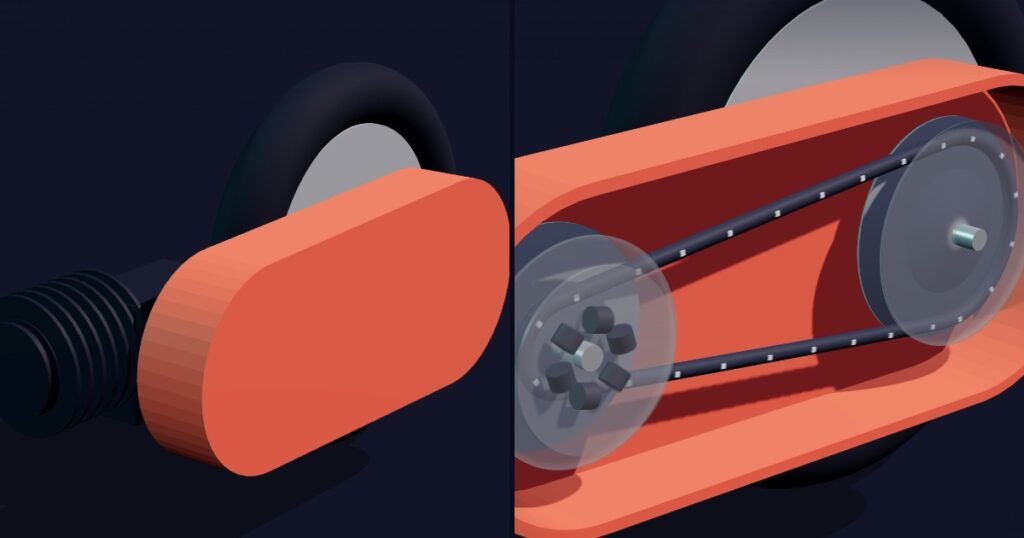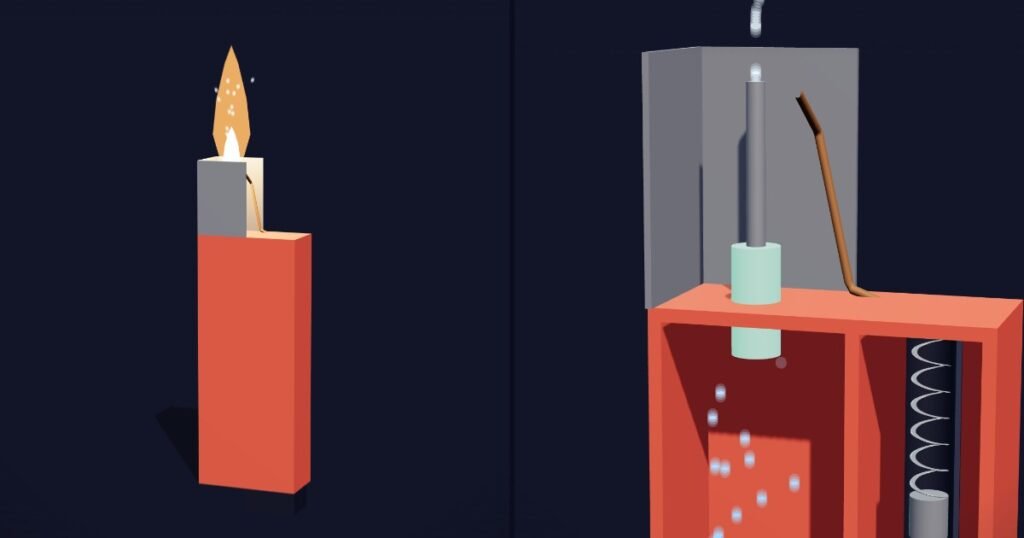

Honda’s first inverter generator, the 1987 EX300, put out a rectangular wave, so it couldn’t run every appliance. Smooth sine-wave output arrived with the EX500 in 1996.
Anatomy: what's inside
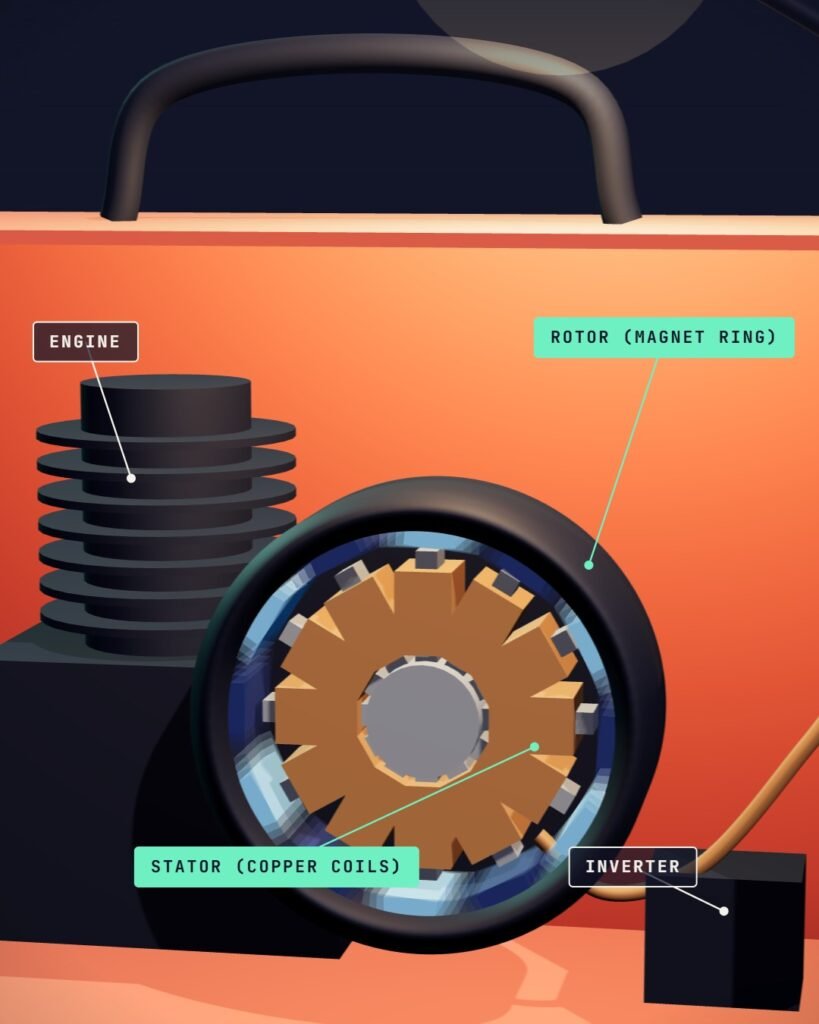
Engine
A small gasoline engine that turns the chemical energy in fuel into rotation. Its only job is to spin the alternator.
Starter
A recoil pull cord, or on electric-start models a starter powered by a battery, gets the engine turning.
Component: BatteryRotor
The spinning part of the alternator. It carries the magnetic field that sweeps past the coils.
Component: MagnetStator
The stationary coils of copper wire around the rotor. The moving magnetic field induces the current here.
Governor
Opens or closes the throttle as the load changes. In a conventional generator it holds the engine at a fixed speed, such as 3,600 rpm for 60 Hz.
Rectifier and inverter
In an inverter generator, turn the alternator’s high-frequency AC into DC, then back into stable AC at the right frequency and voltage.
Outlets and breakers
Deliver the power to your cords. Push-to-reset circuit breakers cut off an outlet if its load is too high.
CO sensor
On some models, shuts the engine off if carbon monoxide builds up around the generator. It does not replace a CO alarm in the home.
Component: SensorAn engine bolted to a magnet
A portable generator looks like one machine, but it is really two. On one side is a small gasoline engine, much like the one in a lawnmower. On the other is an alternator, the part that actually makes electricity. The engine’s only job is to spin the alternator. You start it with a pull cord or, on electric-start models, a starter powered by a small battery.
In other words, a generator does not create energy. It converts it: the chemical energy in fuel becomes motion in the engine, and the alternator turns that motion into electrical energy, the same mechanical-to-electrical conversion the U.S. Energy Information Administration describes for the generators in power stations.
Faraday’s trick: move a magnet, get a current
Almost every generator on Earth, from a power-station turbine to the one in your shed, relies on a discovery from 1831. As the EIA explains, Michael Faraday found that moving a magnet inside a coil of wire makes, or induces, an electric current flow through the wire.
The key word is moving. A magnet sitting still next to a coil does nothing. It is the changing magnetic field, as the magnet sweeps past the wire, that pushes electrons along. Spin the magnet and the field through the coil keeps changing, so the current keeps flowing. The OpenStax College Physics textbook adds that the faster a generator is spun, the greater the voltage it induces.
Inside the alternator, the spinning part is called the rotor and the stationary coils around it are called the stator. The owner’s manual for Generac’s GP Series portable generators refers to both. The rotor carries the magnetic field; the stator windings are where the electricity appears.
Why the current alternates
As the rotor turns, each coil in the stator sees a north pole sweep past, then a south pole. The current is pushed one way, then the other. That is alternating current, the same kind that comes out of a wall socket. Steady spinning gives a smooth, wave-shaped voltage.
In a simple alternator with one north and one south pole, each turn of the rotor produces one full cycle of current. So the speed of the engine directly sets the frequency of the electricity. Generac’s GP Series manual lists the rated frequency as 60 Hz at 3,600 rpm: 3,600 turns a minute is 60 turns a second, and 60 cycles a second. A two-pole machine built for countries that use 50 Hz power would need to turn at 3,000 rpm.
Holding the speed when the load changes
This creates a problem. Plug in a heater or start a power tool and the alternator gets harder to turn. If the engine slowed down, the frequency would drop with it. So a conventional generator has a governor that opens the throttle to hold the engine at the same speed, whether it is powering a single lamp or running flat out.
Generac warns that some electric motors, such as induction types, need about three times more watts to start than to run, and that the surge lasts only a few seconds. That is why generator ratings list a higher surge figure as well as the rated power. The GP6500, for example, is rated at 6.5 kW, with 8.125 kVA of surge.
How much can it run?
Generac’s manual gives a simple way to avoid overloading:
- Add up the watts. Total everything you will connect at once; it should not exceed the generator’s capacity. If a label gives only amps, multiply volts by amps.
- Allow for starting watts. For motor loads such as a refrigerator or sump pump, Generac’s wattage guide says to allow three times the listed watts for starting.
- Expect less up high and in heat. Generac says maximum power drops about 3.5 percent for each 1,000 feet above sea level, and about 1 percent for each 10°F above 60°F.
Inverter generators: make it messy, then clean it up
Running an engine at full speed all the time is noisy and wastes fuel when the load is small. Inverter generators break the link between engine speed and frequency. In Honda’s design, the power takes a detour:
- Generate. The engine spins a high-speed alternator with many poles, which makes high-frequency, three-phase alternating current.
- Rectify. A rectifier circuit turns that rough AC into direct current.
- Invert. An inverter turns the direct current back into alternating current with a stable frequency and voltage.
- Adjust. Because the output no longer depends on the engine, a controller can let the engine slow down when little power is needed.
Honda says that this way, electricity with a constant frequency can be generated regardless of engine speed. Its Eco Throttle automatically adjusts engine speed to the optimum level for the load through a load-dependent electric governor, which saves fuel and makes the generator quieter. Honda’s figures for its EU16i fit that picture: 59 dB(A) at rated output, 54 dB(A) at a quarter load, though Honda also credits two-layer soundproofing.
How clean is clean power?
Honda’s brochure says computers and other sensitive equipment need “clean power”, current that is consistent and has a stable sine wave. One measure of that is total harmonic distortion, or THD: the lower the number, the cleaner the power. In a help article, Generac says a conventional GP6500 with a lower-cost alternator measures 20 percent THD at rated load, while 5 percent THD is now standard in its inverter generators.
It wasn’t always so. Honda’s first generator with an inverter circuit was the EX300, released in 1987. It produced a rectangular wave, so it could not be used with all appliances. Honda introduced sine-wave output with the EX500 in 1996. Freed from a fixed speed, it could rev higher and needed an engine only half the size of a conventional generator’s.
With its EU series in 1998, Honda designed the alternator to double as the engine’s flywheel, which it says cut the generator’s weight by a third. By 2001, the EU16i weighed 21 kilograms, roughly half as much as similarly classed generators, according to the company.
The deadly part is the exhaust
A generator is an engine, and engines make carbon monoxide. The U.S. Consumer Product Safety Commission calls it the “invisible killer” because it is a colorless, odorless, poisonous gas. It links more than 100 U.S. deaths a year to portable generators, and says one produces as much carbon monoxide as hundreds of cars. In its safety alert, the CPSC says a generator in a confined space can produce high levels of CO within minutes.
The CDC warns that people who are asleep can die from CO poisoning before they have symptoms. Between them, the two agencies advise:
- Never run it indoors. Not in a home, garage, basement, crawlspace or shed, even with fans running or doors and windows open.
- Keep it 20 feet away. Run it outside only, at least 20 feet (about 6 meters) from the house, as the CPSC puts it, and away from windows, doors and vents, with the exhaust pointing away.
- Fit CO alarms. Use battery-operated alarms, or plug-in alarms with battery backup, near every sleeping area.
- Know the signs. The CDC lists headache, dizziness, weakness, upset stomach, vomiting, chest pain and confusion.
- Act fast. If you feel sick, dizzy or weak, get to fresh air right away, then call 911.
Some newer models add a safety net: Generac’s COsense system, where fitted, shuts the engine off automatically if it detects carbon monoxide building up, though the manual stresses that it is not a substitute for an indoor CO alarm.
Rain, fuel and hot metal
The CPSC says generators pose a shock risk, especially in wet conditions. In rain, run it under an open, canopy-like structure on a dry surface, and dry your hands before touching it. Before refueling, turn it off and let it cool, because gasoline spilled on hot engine parts could ignite. Generac asks for 5 feet of clear space all around, to prevent overheating and fire.
Never plug a generator into a wall socket
It can seem like a shortcut to power the whole house through an ordinary outlet. The CPSC calls this “backfeeding” and says it is extremely dangerous: it presents an electrocution risk to utility workers and neighbors served by the same utility transformer, and it bypasses some of the house’s built-in circuit protection.
The safe ways are to plug appliances into the generator with heavy-duty extension cords made for outdoor use, or to have a qualified electrician install a transfer switch. The CPSC adds that each cord’s wattage rating should exceed the total load on it. Generac explains that a transfer switch must isolate the generator power from the utility power at all times.
How it works, step by step
Burn
The engine burns fuel and turns its crankshaft.
Spin
The crankshaft spins the alternator’s rotor and its magnetic field.
Induce
The moving field sweeps past the stator coils and induces a current in them.
Alternate
As north and south poles pass each coil in turn, the current reverses direction, producing AC.
Regulate
A conventional generator’s governor holds the engine speed steady to keep the frequency right. An inverter generator converts the output to DC and back to clean AC instead, letting the engine slow down at light load.
Myth vs fact
A generator creates energy.
It only converts it. Fuel becomes motion in the engine, and the alternator turns that motion into electricity.
Running a generator in the garage is fine if the door is open.
The CPSC says never to use one inside homes or garages, even with doors and windows open. Carbon monoxide can build up to deadly levels within minutes.
Plugging a generator into a wall socket is an easy way to power the house.
This “backfeeding” can electrocute utility workers and neighbors on the same transformer. Use a transfer switch installed by a qualified electrician.
A generator’s rated watts are all you need to check.
Some motors need about three times more power to start than to run, so allow for the starting watts of the largest motor.
Generator exhaust contains carbon monoxide, a colorless, odorless gas that can kill within minutes. Run a generator outdoors only, at least 20 feet from the house with the exhaust pointing away, never in a garage, shed or crawlspace. Fit CO alarms, never plug a generator into a wall outlet, and turn it off and let it cool before refueling.
Questions people ask
How does a generator make electricity?
An engine spins a magnetic rotor inside coils of wire. As Michael Faraday discovered in 1831, a moving magnet induces a current in a coil, and because north and south poles pass in turn, that current alternates.
What is the difference between an inverter and a conventional generator?
A conventional generator must run at a fixed speed, such as 3,600 rpm for 60 Hz. An inverter generator turns its output into DC and back into stable AC, so the frequency no longer depends on engine speed. The engine can slow down at light load, which saves fuel and reduces noise.
Is an inverter generator safe for laptops and phones?
Inverter generators are designed to deliver stable, sine-wave power for sensitive electronics, which Honda calls “clean power”. Generac says 5 percent total harmonic distortion is now standard in its inverter generators, while one of its conventional models measures 20 percent at rated load. Check the specifications of the model you use.
How far from the house should a generator be?
The CPSC says at least 20 feet away, outdoors only, with the exhaust facing away from the home, and never inside a garage, even with the door open. The CDC adds: keep it away from windows, doors and vents.
Can I connect a portable generator to my house wiring?
Only through a transfer switch installed by a qualified electrician. Plugging a generator into a wall outlet, called backfeeding, can electrocute utility workers and bypasses some household circuit protection.
Sources
Published by Cut It Open. Checked against every listed source before publishing.
Facts last verified 2026-10-26
Published October 30, 2026 · Updated November 1, 2026