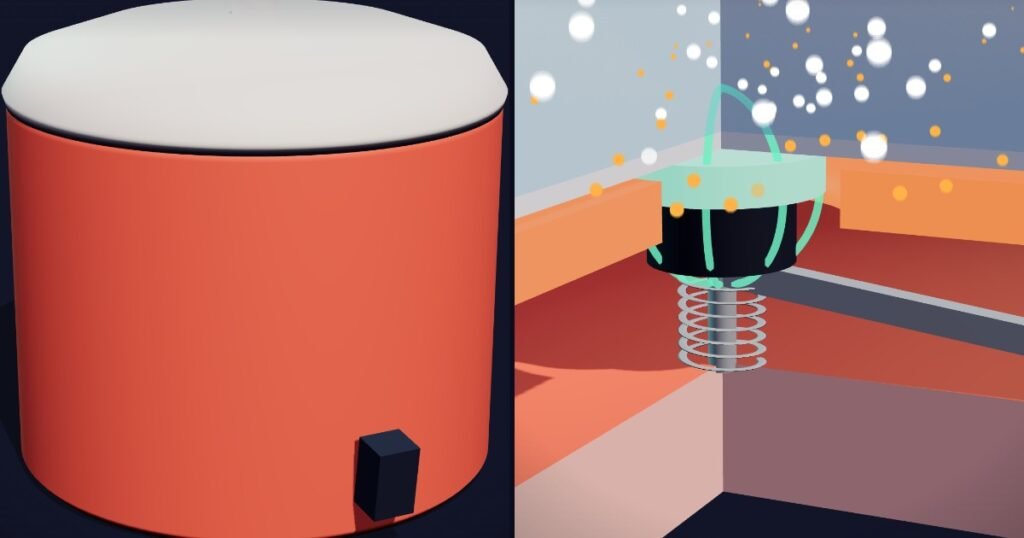
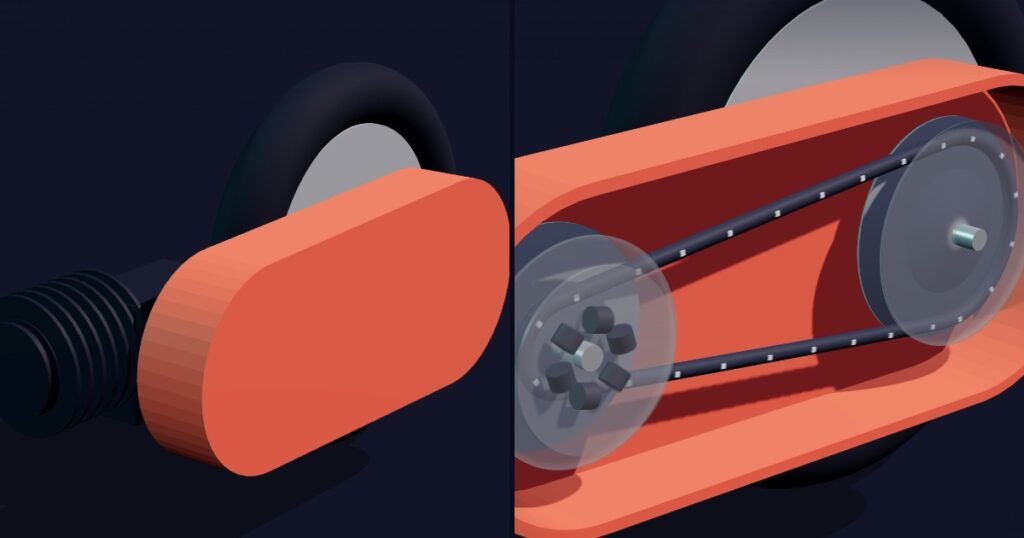
Not every CVT belt is all rubber. A Yamaha patent describes a belt built from blocks of aramid-reinforced resin linked by rubber. It stretches about 0.4 percent early in its life, then barely changes.
Anatomy: what's inside
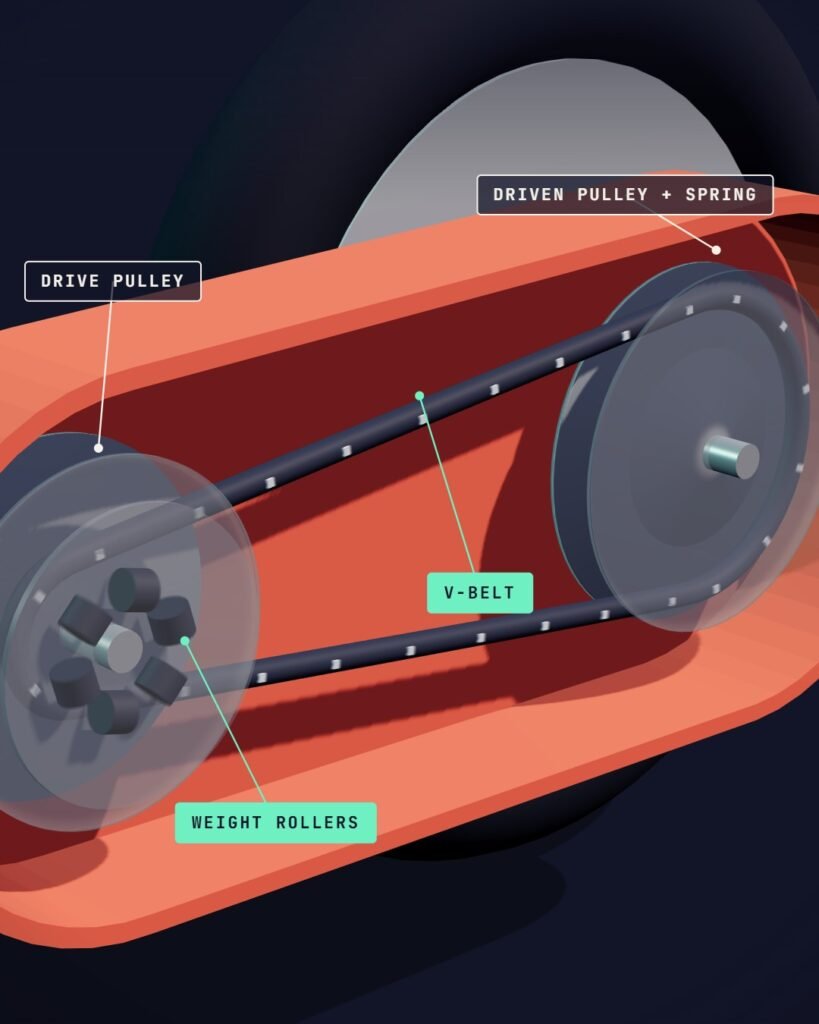
Drive pulley
The front pulley, turned by the engine. One half is fixed and the other slides along the shaft to change the size of the circle the belt runs on.
Component: PulleyCam plate
A plate fixed to the shaft behind the drive pulley’s movable half. The rollers sit between the two, so as they move outward they press the movable half inward.
Weight rollers
Heavy rollers behind the movable half of the front pulley. Centrifugal force throws them outward as the engine speeds up, squeezing the pulley closed. In conventional designs they are softer than the parts they touch, so they wear first, a Yamaha patent notes.
V-belt
Carries the engine’s force from the front pulley to the rear pulley through friction, riding higher or lower in each pulley as the ratio changes. Friction heats it, so it needs cooling air.
Component: BeltDriven pulley
The rear pulley. Its movable half slides apart as the front pulley closes, so the belt runs on a smaller circle there.
Component: PulleyTorque spring
Pushes the halves of the rear pulley together, holding a low ratio until the rollers at the front push harder.
Component: SpringTorque cam
A sloped cam groove on the rear pulley that turns the twisting force of the load into a push on the pulley, so the ratio responds to load as well as speed.
Centrifugal clutch
Shoes that swing out and grip a drum once the rear pulley turns faster than a set speed, so the engine can idle while the scooter stands still.
Final reduction gears
A fixed set of gears that reduces the speed in two steps between the clutch and the rear axle.
Component: GearA gearbox with no gears
On a motorcycle with a manual gearbox, you pull in a clutch lever and click through the gears. A twist-and-go scooter has neither lever. You open the throttle and it pulls away smoothly, then keeps accelerating to cruising speed without a single gear change.
The part that makes this possible is a continuously variable transmission, or CVT. As Yamaha describes it, a CVT transmits drive force while continuously changing the reduction ratio, the equivalent of a gear. It is made of a belt with a V-shaped cross-section running between front and rear pulleys with valley-shaped grooves, and the drive force reaches the rear wheel through the friction between the belt and the pulleys.
Instead of a handful of fixed gears, a CVT can sit at any ratio between its lowest and highest. And on most scooters, it chooses that ratio by itself, mechanically.
Two pulleys that change size
Each pulley is really two cone-shaped halves facing each other, with the belt running in the V-shaped gap between them. A Honda patent calls them the fixed pulley piece and the movable pulley piece: one half is fixed, and the other can slide along the shaft.
Push the two halves together and the gap narrows, forcing the belt outward to run around a bigger circle. Pull them apart and the belt sinks down into the V, running around a smaller one. So a pulley that cannot change its shape can still change its effective size.
Because the belt never changes length, the two pulleys always move in opposite directions: when the belt climbs higher on one, it has to sink deeper on the other.
That pair of circles is the gear ratio. A small circle at the front and a large one at the back is like first gear: the engine turns many times for each turn of the rear pulley, which multiplies its force for pulling away. A large circle at the front and a small one at the back is like top gear, for cruising.
Weights that slide out as the engine speeds up
Inside the front pulley, behind the movable half, sit a set of heavy rollers. As the engine spins faster, centrifugal force throws them outward. A Yamaha patent on belt CVTs for motorcycles shows where they sit: between the movable half and a cam plate fixed to the shaft.
As the rollers move out, they push the movable half toward the fixed half, so the belt climbs to a larger circle at the front. At the back, the Honda patent explains, the movable half moves apart from the fixed half while compressing a spring, so the belt’s circle there becomes smaller.
At every moment, the ratio is set by a tug-of-war. The rollers, pushed by engine speed, try to shift the transmission up. The spring at the rear pulley pushes back, trying to keep it in a low ratio. Where those two forces balance is where the transmission sits.
Why the engine sound stays almost the same
This balance explains something every scooter rider notices. Open the throttle fully and the engine revs up quickly, then holds a fairly steady note while the scooter keeps gaining speed. Instead of the revs rising, the pulleys keep shifting toward a higher ratio.
So the mass of the rollers matters. A patent on CVT flyweights explains that doubling the mass of a flyweight can double the force acting on it at a given rpm, and that lighter flyweights make a CVT clutch engage at a higher rpm and shift into higher ratios less quickly. The patent covers the CVTs used in off-road vehicles, but the same physics applies to a scooter’s rollers: heavier weights shift up at lower engine speed, and lighter weights keep the engine revving higher.
The torque cam: reacting to load, not just speed
Pulling away with a passenger or climbing a steep hill needs a lower ratio than cruising on the flat at the same engine speed.
Yamaha’s answer, on its 1981 BELUGA scooter, was a mechanism called a torque cam, drawing in part on the design of CVTs used on snowmobiles. Yamaha says it made it possible to provide optimum reduction ratios based on the drive load. In the Honda design, the rear pulley’s movable half is guided by a sloped cam groove, so when the two halves try to turn at different speeds, the movable half moves both around the shaft and along it. The twisting force from the load is turned into a push that changes the pulley’s width.
The clutch that lets you stop without stalling
An engine has to keep running while the scooter stands still at traffic lights, so something must disconnect it from the wheel: a centrifugal clutch, with no lever at all.
In the Honda design, a centrifugal starting clutch sits on the rear pulley’s shaft. When that shaft turns faster than a set speed, its clutch shoes swing outward until their friction lining presses against the surrounding drum, and the clutch connects. At idle the shoes stay tucked in, the drum stays still, and the scooter does not move. Slow down, and the shoes pull back in before the engine can stall.
The path from engine to wheel
After the clutch, the shaft still spins much faster than the wheel should. In the Honda patent, a final reduction gear slows it in two steps on the way to the rear axle. These are the only gears in the drivetrain, and their ratio never changes. So the engine’s power takes this route:
- Drive pulley. Turned by the engine, with the rollers inside.
- V-belt. Carries the force rearward by gripping both pulleys.
- Driven pulley. Its spring and torque cam decide how far it opens.
- Centrifugal clutch. Connects once the shaft turns fast enough.
- Final reduction gears. Two fixed steps down to wheel speed.
From BELUGA to electronic CVTs
Yamaha’s Passol, released in 1977, had no transmission at all. The BELUGA 50 of 1981 was Yamaha’s first mass-production scooter with a CVT. Yamaha says the CVT was later adopted on all its scooters from 50cc up to 250cc and 400cc.
Some larger scooters now control the pulleys electronically. Yamaha’s Majesty YP250 lets the rider choose from three transmission modes. In a 2005 SAE technical paper, Honda engineers described an electronically controlled scooter CVT that calculates its ratio from throttle opening and drive speed, with two automatic modes and a six-speed manual mode. A later Yamaha patent describes an electric motor that moves the front pulley’s movable half.
Heat, the belt’s hidden enemy
A belt that grips by friction also makes heat. In the Honda patent design, air drawn in through a shroud cools the belt. When Honda announced its CV-Matic for Cub-style scooters in 2009, it said a new cooling system protects the drive belt from high temperatures and improves its durability.
Slipping makes it worse. Belt maker Gates warns that a badly tuned variator and clutch cause excessive slippage, and the heat can glaze a belt within a few kilometers. It traces glazing to dirty pulleys, worn rollers or weakened springs.
What wears out
A CVT works by friction, so friction parts wear. The belt carries all of the engine’s force through its grip on the pulleys, the rollers slide back and forth again and again on every ride, and the clutch shoes rub against the drum each time you pull away.
Describing a problem with conventional designs, the Yamaha patent notes that the rollers are softer than the parts they press on, so they wear first. Worn rollers can’t push the pulley fully closed, and the patent describes the result: higher engine speed and lower road speed.
Suzuki’s guideline is to inspect the drive belt at 12,000 km (about 7,500 miles) or two years, whichever comes first. Gates suggests preventive replacement between 18,000 and 30,000 km (about 11,000 to 19,000 miles), depending on the scooter. Your owner’s manual has the figure for your model. Signs and habits worth knowing:
- Slipping, a wandering ratio or new noises. Suzuki lists all three as results of running a belt too long. In the worst case, the belt breaks.
- More revs, less speed. The symptom the Yamaha patent ties to worn rollers.
- Cracks in the belt. Gates says cracks usually mean a belt is past its service life and should be replaced right away.
- Go easy on a new belt. Gates recommends about 50 km (30 miles) of break-in, without hard launches.
- Don’t rev against the brakes. Gates lists opening the throttle while braking as a cause of burn marks on the belt.
How it works, step by step
Idle
The engine turns slowly. The clutch shoes stay tucked in, so the rear wheel is disconnected and the scooter stands still.
Pull away
Open the throttle and the rear pulley speeds up until the clutch shoes swing out and grip. The belt starts on a small circle at the front and a large one at the back, a low ratio for pulling away.
Shift up
As engine speed rises, the rollers move outward and squeeze the front pulley closed. The belt climbs at the front and sinks at the back, raising the ratio.
Cruise
At speed, the belt runs on a large circle at the front and a small one at the back, like top gear.
React to load
On a hill or with a passenger, the spring and torque cam at the rear pulley push back, moving the transmission toward a lower ratio.
Slow down
As the engine slows, the rollers move back in, the ratio drops, and the clutch shoes release before the engine can stall.
Myth vs fact
A scooter’s automatic transmission is full of gears.
The ratio is changed by a belt and two pulleys. The only gears are a fixed final reduction between the clutch and the rear wheel.
If the engine sound stays the same, the scooter isn’t accelerating.
A CVT can hold the engine at a fairly steady speed while the pulleys keep shifting to a higher ratio, so the scooter speeds up without the revs rising.
Changing the roller weights does nothing.
Roller mass sets how hard they push at a given engine speed. Lighter weights keep the engine revving higher before the ratio changes; heavier weights shift up sooner.
A drive belt is fine until it snaps.
A worn belt can slip, make noise and let the ratio fluctuate. Breaking is the worst case. Suzuki’s guideline is to inspect the belt at 12,000 km (about 7,500 miles) or two years, whichever comes first, though intervals vary by model.
The CVT case holds a belt, pulleys and a clutch that spin fast and get hot after a ride. Never run the engine with the CVT cover removed, let it cool before touching it, and leave belt, roller and clutch replacement to the procedure in your service manual or a qualified mechanic.
Questions people ask
How does a scooter CVT work?
A V-belt runs between two pulleys made of sliding halves. As engine speed rises, weighted rollers squeeze the front pulley closed so the belt rides on a bigger circle, while the rear pulley opens and the belt rides on a smaller one. That changes the ratio smoothly, with no gears to shift.
Why doesn’t a scooter stall when I stop?
A centrifugal clutch disconnects the engine from the rear wheel at low speed. Its shoes only swing out and grip the drum when the rear pulley turns faster than a set speed.
What do the rollers in a scooter variator do?
They are the speed sensor. Centrifugal force throws them outward as the engine speeds up, and they push the front pulley closed to raise the ratio. Their mass decides at what engine speed that happens.
Why does my scooter rev high but feel slow?
Worn rollers and a slipping belt are two possible causes. A Yamaha patent describes worn rollers raising engine speed and lowering road speed, and Suzuki lists belt slip as a result of running a belt too long. Have the CVT inspected by a qualified mechanic.
How often should a CVT belt be replaced?
It depends on the model. Suzuki’s guideline is to inspect the drive belt at 12,000 km (about 7,500 miles) or two years, whichever comes first. Belt maker Gates suggests preventive replacement between 18,000 and 30,000 km. Your owner’s manual gives the interval for your scooter.
Sources
Published by Cut It Open. Checked against every listed source before publishing.
Facts last verified 2026-10-26
Published October 29, 2026 · Updated October 25, 2026