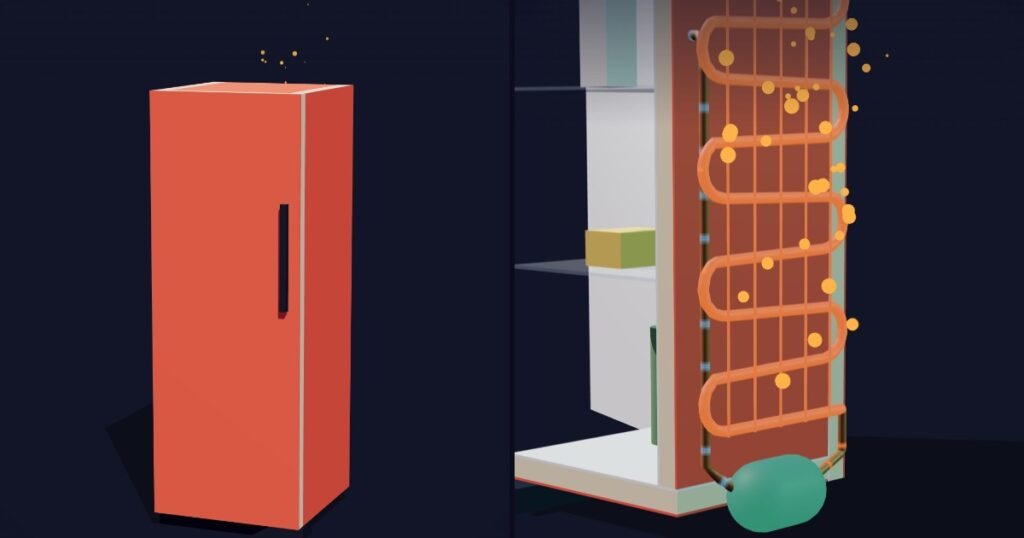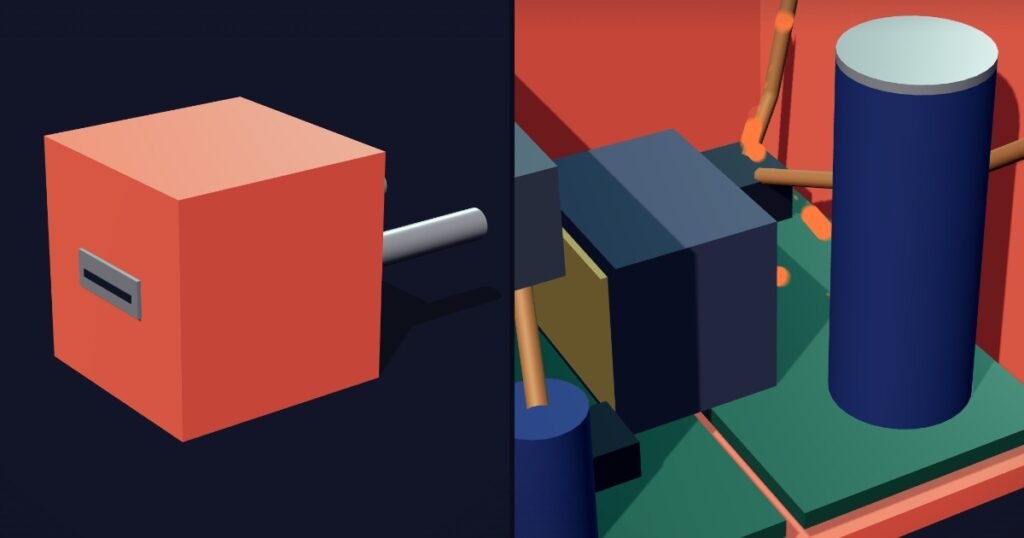
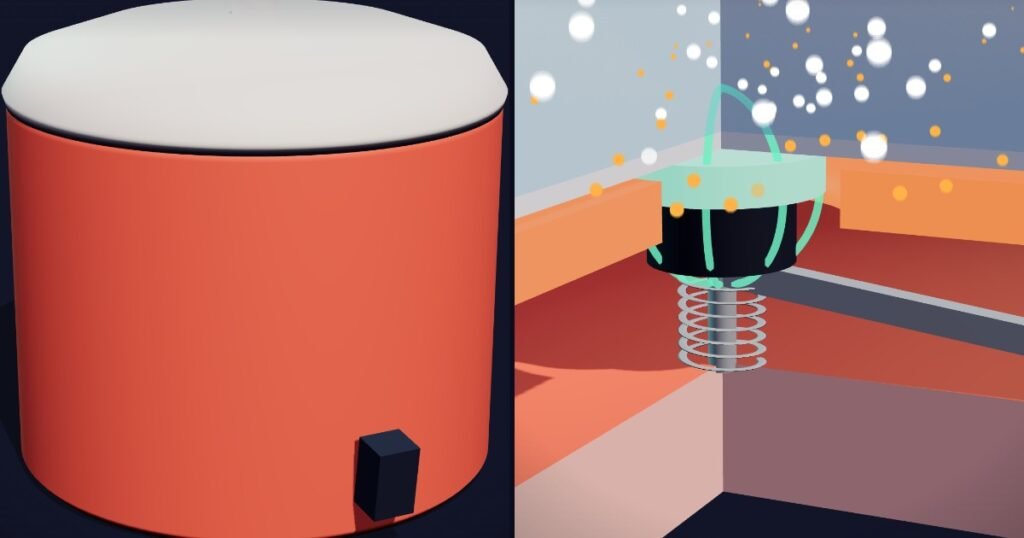
The first automatic rice cooker, Toshiba’s ER-4 from 1955, cost about a third of the average Japanese monthly salary. Within a year, Toshiba was selling more than 200,000 a month.
Anatomy: what's inside
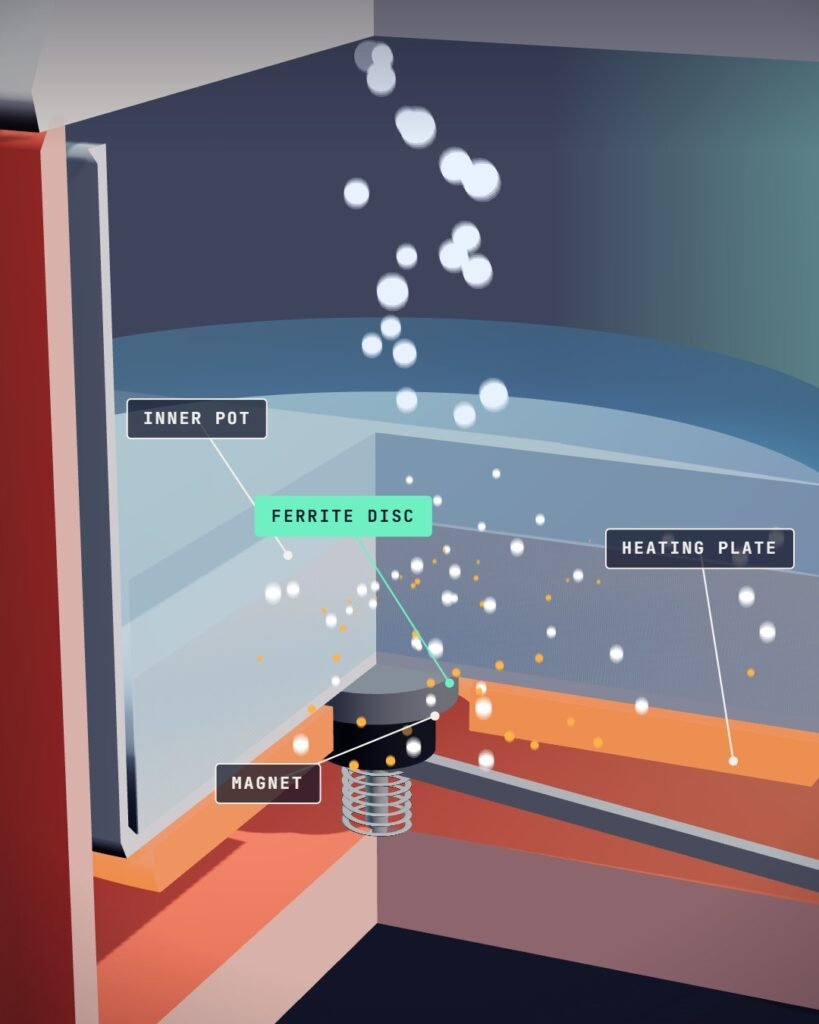
Inner pot
The removable pot that holds the rice and water. In induction models it is also the part that heats up.
Heating plate
An electric element under the pot that heats it from below. Some models also heat from the lid.
Component: Heating ElementTemperature switch
The round button in the middle of the plate. It presses against the pot and opens the cooking circuit once the pot gets hotter than boiling water.
Component: ThermostatFerrite and magnet
Hold the switch closed by magnetism. Above its Curie point, the ferrite stops being magnetic and the switch lets go.
Component: MagnetCook lever
Closes the switch to start cooking. It pops back up with a click when the ferrite lets go.
Keep-warm heater and switch
A separate warming heater that switches on whenever the pot cools to a set level, so the rice stays warm after cooking.
Component: Heating ElementMicrocomputer and sensors
In Micom and fuzzy logic models, a chip controls temperature and time, including soaking and steaming.
Component: SensorInduction coil
In IH models, a coil under the pot carries a rapidly changing current. Its electromagnetic field makes the pot heat itself, instead of a plate heating it from below.
A rice cooker doesn’t know what time it is
A basic rice cooker has one lever, one light and no clock. Yet it stops at the right moment whether you cook one cup of rice or five. It never measures time. It watches temperature, and it lets the water in the pot do the timing.
Take one apart and there is surprisingly little inside: a heating plate, a removable pot, a small round button in the middle of the plate, and a switch that is held closed by magnetism.
Water is the timer
At sea level, water boils at 100°C (212°F). While there is liquid water in the pot, the energy from the heating plate goes into turning water into steam instead of making the pot hotter. So for most of the cooking cycle, the bottom of the pot sits close to boiling point, no matter how hard the heater works.
Meanwhile the rice absorbs water, and some of it boils away. When the free water is gone, nothing holds the temperature down any more. As Zojirushi explains, as soon as all the water is absorbed by the rice, the temperature inside the cooker immediately rises, and the thermostat detects the rise above 212°F and turns the heater off.
That is why the amount of water, not a clock, sets the cooking time. A bigger batch has more water to absorb and boil off, so it takes longer to reach the temperature jump.
The magnet that lets go
The round button in the middle of the heating plate presses against the bottom of the inner pot. It is the temperature switch. A rice cooker patent describes the conventional design: a lever acts as the power switch and turns on the automatic temperature switch located under the inner pot, which connects the cooking heater to the mains.
What keeps that switch closed is magnetism, and the part that matters is a piece of ferrite, a magnetic ceramic. Every magnetic material has a Curie point, a temperature above which it stops being magnetic. In a rice cooker switch, that point has to sit above the boiling point of water, or the switch would trip while there is still water in the pot.
While there is water in the pot, the ferrite never gets hot enough to lose its grip. Once the water runs out and the pot heats past boiling, the ferrite passes its Curie point. In the words of the patent, it loses its magnetic characteristics and the switch opens. The lever pops up with that familiar click, and the cooking heater is disconnected.
There is no chip and no software in this loop. The material itself is the sensor. The ferrite becomes magnetic again as it cools, but the switch stays open until you press the lever for the next batch.
Keep warm: a second, gentler circuit
Switching off the main heater doesn’t leave the rice to go cold. The same patent describes a separate keep-warm switch that turns on a separate warming heater whenever the pot cools to a set level.
This simple switch has a catch. The patent notes that the switch has a high tolerance on its operating temperature, so some conventional cookers get hot enough to scorch the rice at the bottom of the pot.
Keep warm has limits, too. Zojirushi says 12 hours is the maximum for most of its cookers, and to check the instruction manual for yours.
One batch, start to finish
Here is the whole cycle in a basic cooker:
- Start. Pressing the lever closes the temperature switch, and the cooking heater brings the water to a boil.
- Hold. While free water remains, the pot stays near boiling as the rice soaks it up and some steams away.
- Jump. Once the free water is gone, the bottom of the pot heats past boiling point.
- Click. The ferrite passes its Curie point, the switch opens and the lever pops up.
- Warm. The keep-warm switch turns on the warming heater whenever the pot cools to a set level.
The first automatic rice cooker used a bending metal strip
According to IEEE Spectrum, Toshiba’s ER-4 went on sale on 10 December 1955 and was the world’s first automatic rice cooker. It was built as a double boiler, a pot within a pot for indirect heating, and used evaporation to mark time.
Instead of a magnet, it used a bimetallic switch, a strip of two metals that expand at different rates and so bend as they heat. The switch measured the temperature of the outer pot, where one cup of boiling water took 20 minutes to evaporate. When the temperature passed 100°C, the strip bent and cut the circuit. Cheap cookers still use the same idea: wait for the water to run out, then react to the jump in temperature.
The cooker came from a partnership between Toshiba and Yoshitada Minami, the manager of a small family factory. His wife, Fumiko, spent five years researching and testing to find the ideal recipe. It cost 3,200 yen, about a third of the average Japanese monthly salary at the time, yet within a year Toshiba was selling more than 200,000 a month.
Micom and fuzzy logic: a computer instead of a magnet
More expensive cookers replace the magnetic switch with a microcomputer. Zojirushi calls these Micom models, short for “micro computerized”: a microcomputer chip controls the temperature and cooking time.
A basic cooker will simply boil rice and turn off when there is no water left in the pot. You handle the soaking and steaming yourself. Zojirushi says rice should soak for about 30 minutes to cook well, and that Micom cookers are pre-programmed to soak the rice before cooking and steam it afterward. That is also why a Micom cycle can take longer than cooking rice on the stove.
Some models go further and advertise “fuzzy logic”. Fuzzy set theory was introduced by Lotfi Zadeh in the 1960s and, as Zojirushi puts it, mimics human reasoning. Instead of a single on/off threshold, the controller can typically adjust heat and time by degrees.
Induction heating: the pot becomes the heater
In a conventional cooker, a bottom plate heating element warms the inner pan, and some models also heat from above. Induction heating (IH) models work differently.
A coil under the pot carries a rapidly changing current. As the U.S. Department of Energy explains for induction cooktops, the electromagnetic field transfers currents directly to the cookware, so the heat is created within the cookware itself. In an IH rice cooker, the inner pot is the heater. Zojirushi describes it as using the cooking pan as a conductor. Because the heat starts in the metal of the pot, the controller can respond quickly.
Pressure IH cookers add a sealed lid. Raising the pressure raises the boiling point of water, so the rice cooks hotter than 100°C. Zojirushi says the combination of pressure and high heat improves texture, and notes that its pressure models are not designed for use above 5,000 feet; below that, it says they cook better than non-pressure models.
Looking after the pot and the switch
A little care keeps the pot and the cooker in good shape. Zojirushi’s care advice comes down to a few habits:
- Wipe the outside of the pot. Remove moisture or rice from the outside of the inner pot before putting it back, and, on models that have them, keep the side sensors clean.
- Soak, don’t scrape. If rice hardens in the pot, fill it with water to soften the grains, then use a soft sponge and dish soap.
- Skip abrasives and vinegar. Metal scouring pads, stiff brushes, cleansers and vinegar can scratch, discolor or corrode parts.
- Keep it out of the dishwasher. Zojirushi says its rice cooker parts and accessories are not dishwasher safe.
- Replace a worn pan. A dented or deformed pan, a burnt bottom, or rice that keeps sticking means it is time.
Rice, heat and food safety
Once the lever clicks up, the rice still needs care. The UK Food Standards Agency explains that uncooked rice can contain spores of a bacterium called Bacillus cereus, which can cause food poisoning, and that the spores can survive being cooked. The longer cooked rice is left at room temperature, the more likely it is to become unsafe.
- Chill leftover rice as quickly as possible, ideally within one hour. Smaller portions cool faster.
- Don’t leave rice to cool down in the rice cooker, steamer or pan.
- Keep cooked rice in the fridge for no more than one day before reheating.
- Never reheat rice more than once, and make sure it is steaming hot all the way through.
How it works, step by step
Heat
Pressing the lever closes the switch. The heating plate warms the pot until the water boils.
Hold at boiling
While there is water in the pot, the heat goes into making steam, so the pot stays near 100°C at sea level as the rice absorbs water.
Temperature jumps
When the free water is gone, nothing holds the temperature down and the bottom of the pot heats up quickly.
Switch lets go
The ferrite in the temperature switch passes its Curie point and loses its magnetism. The switch opens and the lever clicks up.
Keep warm
A separate warming heater switches on whenever the pot cools to a set level, holding the rice warm until you serve it.
Myth vs fact
A rice cooker uses a timer.
A basic cooker has no clock. The water in the pot sets the time: the switch reacts when the water runs out and the temperature rises above boiling.
Adding more water only makes the rice softer.
It also makes the cycle longer, because there is more water to absorb and boil away before the temperature can jump.
Rice can be left to cool in the cooker.
The UK Food Standards Agency advises against it. Chill leftover rice as quickly as possible, ideally within one hour.
Keep warm can hold rice for as long as you like.
Zojirushi says 12 hours is the maximum for most of its cookers, and to follow the limit in your manual.
Cooked rice can cause food poisoning if it is left at room temperature, because Bacillus cereus spores survive cooking. Don’t leave leftover rice to cool in the cooker. Chill it within about an hour, keep it in the fridge for no more than a day, and reheat it only once, until steaming hot. Zojirushi advises wiping the outer body with a soft, dry cloth.
Questions people ask
How does a rice cooker know when the rice is done?
It watches temperature, not time. Water keeps the pot near boiling point. When the rice has absorbed the water, the temperature rises quickly and a switch under the pot turns the cooking heater off.
Why does my rice cooker click?
The click is the cook lever popping up. A magnetic temperature switch holds it down while cooking, and lets go once the pot gets hotter than boiling water.
What is the difference between a basic, Micom and induction rice cooker?
A basic cooker heats from a plate and switches off when the water runs out. A Micom cooker uses a microcomputer to control temperature and time, including soaking and steaming. An induction (IH) cooker heats the pot itself with an electromagnetic field, which lets it reach higher temperatures, according to Zojirushi.
How long can rice stay on keep warm?
Follow your manual. Zojirushi says 12 hours is the maximum for most of its rice cookers.
Is it safe to leave cooked rice in the rice cooker?
Not to cool down. The UK Food Standards Agency says to chill leftover rice as quickly as possible, ideally within one hour, and not to leave it to cool in the rice cooker, steamer or pan.
Sources
Published by Cut It Open. Checked against every listed source before publishing.
Facts last verified 2026-10-26
Published October 28, 2026 · Updated October 25, 2026