Zippers were in uniform before they had a name. The National Inventors Hall of Fame says the U.S. Army put them on troops’ clothing and gear in World War I, years before B. F. Goodrich coined the word “zipper” in 1923.
Anatomy: what's inside
Tape
The two fabric strips that are sewn into the garment or bag and carry the teeth.
Elements (teeth)
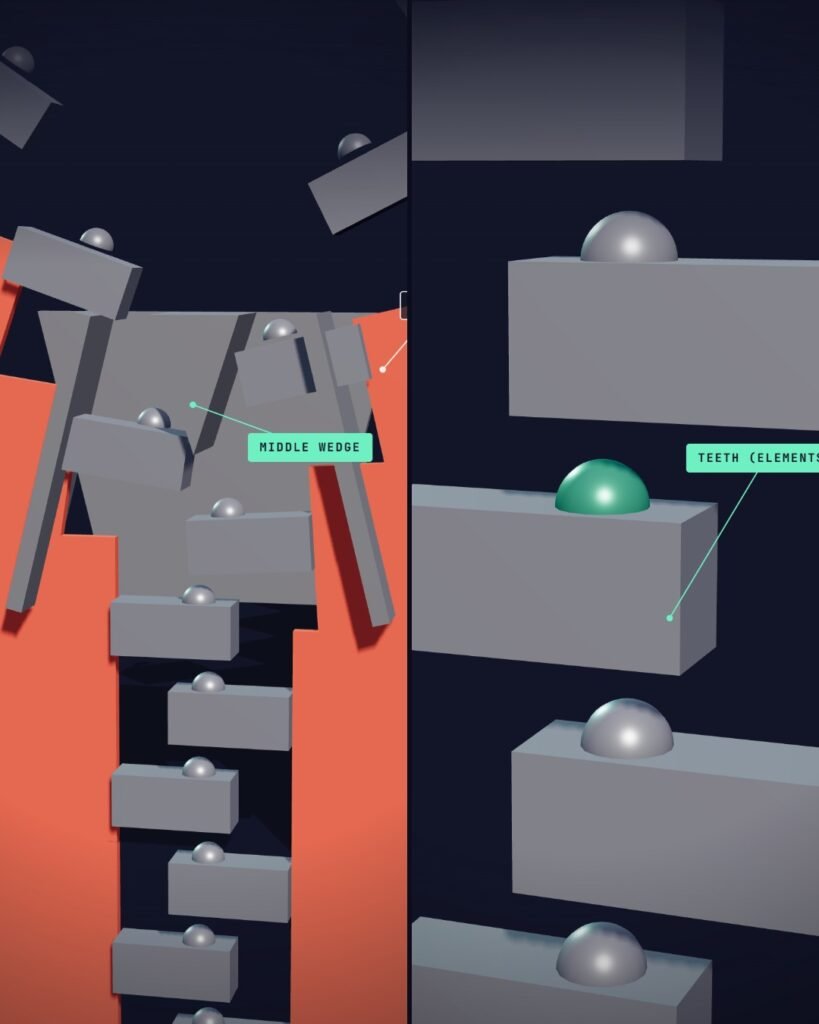
Small teeth with a bump on one face and a hollow on the other, made of metal, molded plastic or a plastic coil. The bump of each tooth nests into the hollow of its neighbor on the opposite tape.
Slider
A Y-shaped channel that bends the two rows together to close the zipper, with a wedge between its two plates that tips the teeth apart to open it.
Component: SliderPull tab
The handle you grip. On locking sliders, its position also engages or releases the lock.
Lock pin
A small pin inside a locking slider that catches between the teeth when the tab is down, so the slider can’t move.
Spring cover
On auto-lock sliders, the top cover acts like a spring that keeps the lock engaged unless you hold the tab.
Component: SpringTop and bottom stops
Small blocks at each end of the teeth that keep the slider from running off the zipper.
Two questions hiding in one
A closed zipper survives a lot. You can sit down in tight jeans, stuff a bag until the seams strain, or yank a jacket over your head, and the two sides stay joined. Yet one small pull on the tab opens the whole thing in a second.
That raises two separate questions. Why don’t the teeth come apart when you pull on the fabric? And why doesn’t the slider simply slide back down on its own? The answers are different, and the second one is the reason zipper makers added a hidden lock.
The teeth: a projection and a pocket
A zipper is two strips of fabric tape, each edged with a row of small teeth, which makers call elements. The rows are staggered, so each tooth on one side sits between two teeth on the other.
Every tooth has the same shape: a bump on one face and a matching hollow on the other. Gideon Sundback’s 1917 patent describes each member as having a recess on one side and a projection of similar shape on the other. When the rows close, the bump of each tooth nests into the hollow of its neighbor, all the way up the zipper. The National Inventors Hall of Fame notes that Sundback’s machine cut these “scoops” from a special Y-shaped wire and punched in the dimples that form the teeth.
The fit has to be exact. YKK says its elements must be made to within one hundredth of a millimeter (0.01 mm), and that a small error can stop a zipper from opening properly, or let a closed one come open from the center.
Exact doesn’t mean tight, though. Look closely at a closed zipper and you will see small, evenly spaced gaps between the teeth. YKK says those gaps are deliberate. If they are too large, the teeth become misaligned. If they are too small, the zipper moves stiffly.
Why pulling the fabric doesn’t open it
When you pull the two sides of a closed zipper apart, you are pulling sideways, across the row. In that direction, every bump is locked inside a hollow, and many teeth share the load at once. Sundback’s patent says the interlocked members hold together with practically no movement of separation, while still being able to rock slightly against each other, which is what lets a zipper bend with the fabric.
YKK tests exactly this with a lateral pull strength test, pulling a zipper chain sideways until it breaks.
To get a tooth out of its neighbor, you have to tip it, lifting the bump up and out of the hollow, one tooth at a time. Bending a zipper sharply can start that tipping. A 1932 disclaimer added to Sundback’s patent even limits the patent to fasteners whose parts are slight enough to be bent sharply across their length. Ordinary pulling never tips the teeth in the right way. That job belongs to the slider.
The slider: a tiny wedge machine
Look inside a slider and you will find a Y-shaped channel: two entrances at the top that merge into one exit at the bottom, with a wedge between them. The idea is older than the modern zipper. Whitcomb Judson’s 1893 patent for a “clasp locker” on shoes used a guide with two channels at one end converging into one at the other, so that pulling it one way drew the clasps together and pulling it the other way separated them, in a single continuous movement.
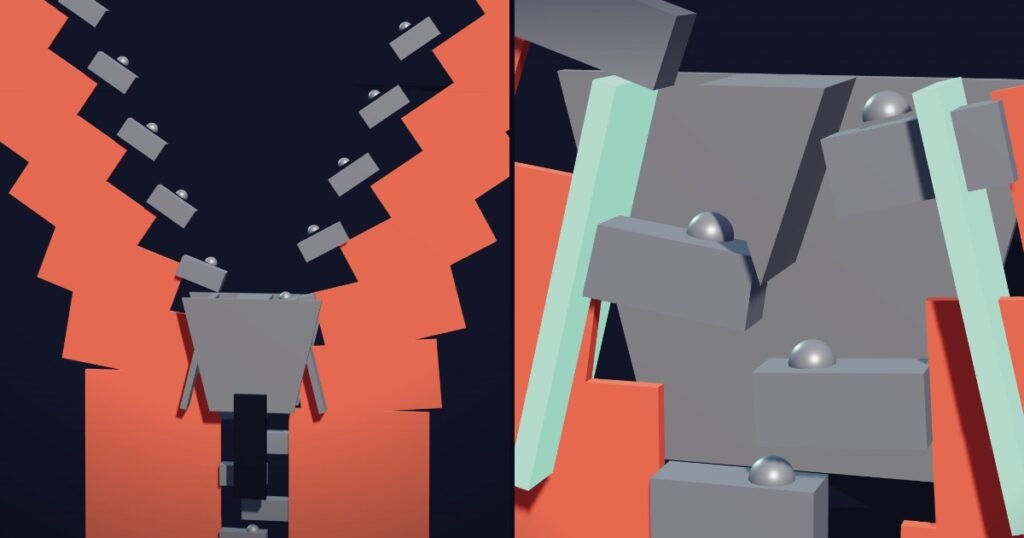
Zip up a locking zipper and four things happen:
- Guide. The two open rows of teeth enter the slider through its two top channels.
- Converge. The channels bend the rows toward each other at just the right angle.
- Nest. Where the channels merge, each tooth slips into place behind the one before it, bump into hollow.
- Lock. You let go of the tab, and on a locking slider a pin catches on the teeth so the slider stays put.
Opening runs the same path in reverse. The wedge, which Sundback’s patent describes as a tongue that engages the members to unlock them, pries the teeth apart in the same controlled order. YKK puts it simply: pulling the slider down through its Y-shaped tunnel widens the gap between the meshing elements. The slider opens the zipper the only way it can be opened: tooth by tooth.
The real danger: a slider that slides
Once the teeth are locked, the only part that can undo them is the slider, and a slider is free to move. YKK explains that zippers originally had no locking function, so the slider could gradually slip down due to gravity as you moved, opening the zipper without you noticing. Zippers with a locking function were developed to stop this.
On jeans, for example, YKK says the zipper doesn’t come open on its own because the slider has a lock. A mechanism hidden inside the slider works together with the pull tab.
How the hidden lock works
There are two common designs.
- Pin lock. When the pull tab lies flat, a part called the lock pin catches on the elements, preventing the zipper from opening or closing. Raising the tab to 90 degrees lifts the pin and releases the lock. YKK Americas says the slider is locked when the pins on the puller are pushed down into the elements.
- Auto lock. The top cover of the slider acts like a spring and holds the lock engaged unless you hold the pull tab. Grip the tab and give it a gentle pull, and the lock lifts out of the way. As YKK Americas puts it, the lock automatically locks when no force is placed on the tab.
YKK Americas lists auto locks for garments and outerwear, where tension can pull a zipper open, and pin locks for items such as bedding, upholstery and purses.
Not every slider needs one. If the zipper on a bag drifts open while the one on your jeans never does, the difference may be that the jeans zipper has a locking slider.
Coil, metal or molded plastic
Not every zipper has metal teeth like Sundback’s. YKK makes three main types. In a coil zipper, the elements are formed from monofilament plastic. In its VISLON zippers, they are made of a plastic called POM resin. Metal zippers use teeth of brass, antique brass or aluminum.
The materials differ, but the principle doesn’t: the shaped faces of the two rows mesh together, which YKK likens to gears.
From shoe clasps to “zipper”
Judson’s clasp locker of 1893 used separate hook-like clasps rather than teeth. According to the National Inventors Hall of Fame, Judson’s clasp locker lacked reliability, so he hired Sundback, an engineer, to make it practical. Sundback made the decisive change. He increased the number of fastening elements from four to ten per inch, creating small teeth, faced two rows of them opposite each other and added a slider to pull them together. He also developed the machine and process to manufacture them.
The name came later. The Hall of Fame says the industrialist B. F. Goodrich coined the onomatopoeic term “zipper” in 1923.
When a zipper catches skin
The same grip that holds fabric can hold skin. KidsHealth notes that skin can get caught in a zipper, typically while someone is zipping a fly up or down. The emergency department guideline at Perth Children’s Hospital says these injuries are most commonly seen in pre-school and early school-age boys.
KidsHealth suggests reminding children to take their time when zipping, so the zipper stays away from the skin. If skin does get trapped, the hospital guideline describes how clinicians handle it: a gentle approach with pain relief first, then methods such as mineral oil with gentle traction, or cutting through the slider’s center bar so its front and back plates separate. These are jobs for trained staff, so get medical help rather than forcing the slider.
Keeping a zipper running
A slider that sticks is usually fighting friction on the teeth. A few habits help:
- Lubricate a stiff zipper. YKK Americas recommends applying paraffin or a zipper lubricant to the front and back of the elements, then running the slider up and down to work it in.
- Don’t force it. Forcing a stuck slider can damage the teeth.
- Concealed zippers: close before washing. YKK’s care notes for its CONCEAL concealed zipper say to close the zipper before washing, to lessen pressure and damage.
- Concealed zippers: close before ironing. The same notes say to iron it closed, at under 130°C (about 266°F), ideally pressing with a damp cloth.
- Use the lock. On a pin-lock slider, fold the tab down flat after closing so the pin can catch on the teeth.
How it works, step by step
Converge
As you pull the slider up, its two entry channels guide the two rows of teeth toward each other at an angle.
Nest
At the bottom of the Y, each tooth’s bump slips into the hollow of the tooth beside it, one after another.
Hold
With every bump locked in a hollow, sideways pulling on the fabric is shared by many teeth and can’t separate them.
Lock
Let go of the tab on a locking slider and its pin drops between the teeth, so the slider can’t creep down.
Open
Lift or grip the tab to release the lock. As the slider moves down, its wedge tips the teeth apart one by one.
Myth vs fact
A zipper stays shut because the teeth are clamped tightly together.
The teeth are shaped to nest, bump into hollow. They stay together because sideways pulling can’t lift a bump out of its hollow, not because they are squeezed.
Zippers never open by themselves.
YKK says early zippers had no lock, so the slider could slip down as you moved. Locking sliders were developed to stop that.
The teeth do the opening.
The slider does. Its wedge tips the teeth apart one at a time, which is the only practical way to separate them.
The tighter the teeth fit, the better the zipper.
YKK says the small, even gaps between closed teeth are deliberate. Too large and the teeth misalign; too small and the zipper moves stiffly.
Skin can get caught in a zipper, most often while zipping a fly, and a children’s hospital guideline says young boys are the most common patients. Remind children to take their time and keep the zipper away from the skin. If skin is trapped, get medical help rather than forcing the slider; a children’s hospital guideline says clinicians free it gently, with pain relief first.
Questions people ask
Why doesn’t a zipper come apart when I pull on the fabric?
Each tooth’s bump sits inside the hollow of the tooth beside it. Pulling sideways can’t lift the bumps out, and the load is shared by many teeth. Only the slider’s wedge can tip them apart.
Why does my zipper keep sliding down?
It probably has a non-locking slider. YKK explains that zippers without a locking function can gradually slip down as you move. Locking sliders use a pin that catches on the teeth to prevent this.
How does a locking zipper slider work?
On a pin-lock slider, a lock pin catches on the teeth when the tab lies flat, and lifting the tab to 90 degrees releases it. On an auto-lock slider, a spring-like cover keeps the lock engaged unless you hold the tab.
Who invented the zipper?
Whitcomb Judson patented a “clasp locker” for shoes in 1893. Gideon Sundback developed the modern design with small interlocking teeth and a slider, patented in 1917. B. F. Goodrich coined the name “zipper” in 1923.
How do I fix a stiff zipper?
YKK Americas recommends applying paraffin or a zipper lubricant to the front and back of the teeth, then moving the slider up and down to spread it. Don’t force a stuck slider, because that can damage the teeth.
Sources
Published by Cut It Open. Checked against every listed source before publishing.
Facts last verified 2026-10-26
Published October 27, 2026 · Updated October 25, 2026