
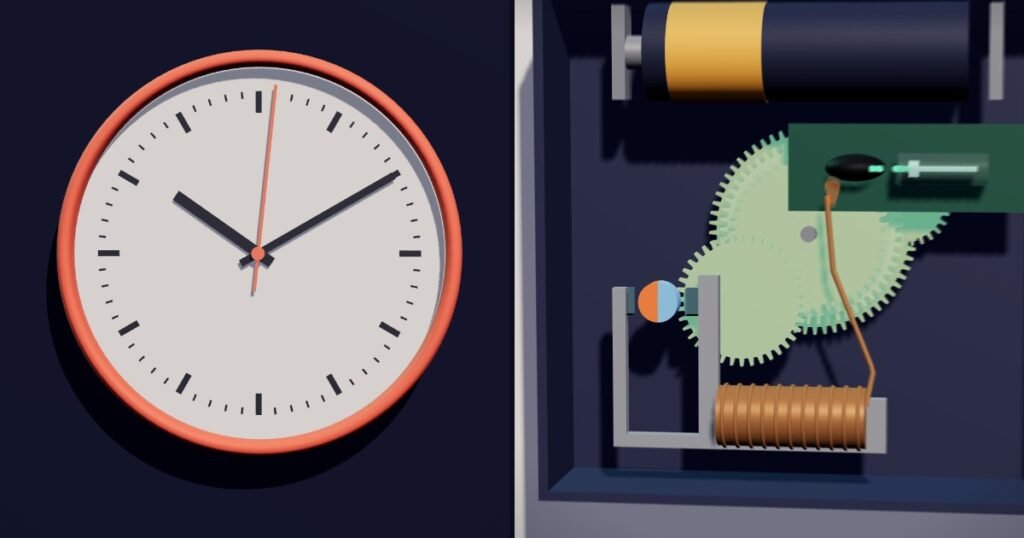
The first quartz wristwatch sold to the public, Seiko’s Quartz-Astron of 1969, used a crystal vibrating 8,192 times a second, a quarter of today’s usual 32,768. The IEEE Milestone record says it was accurate to within five seconds a month.
Anatomy: what's inside
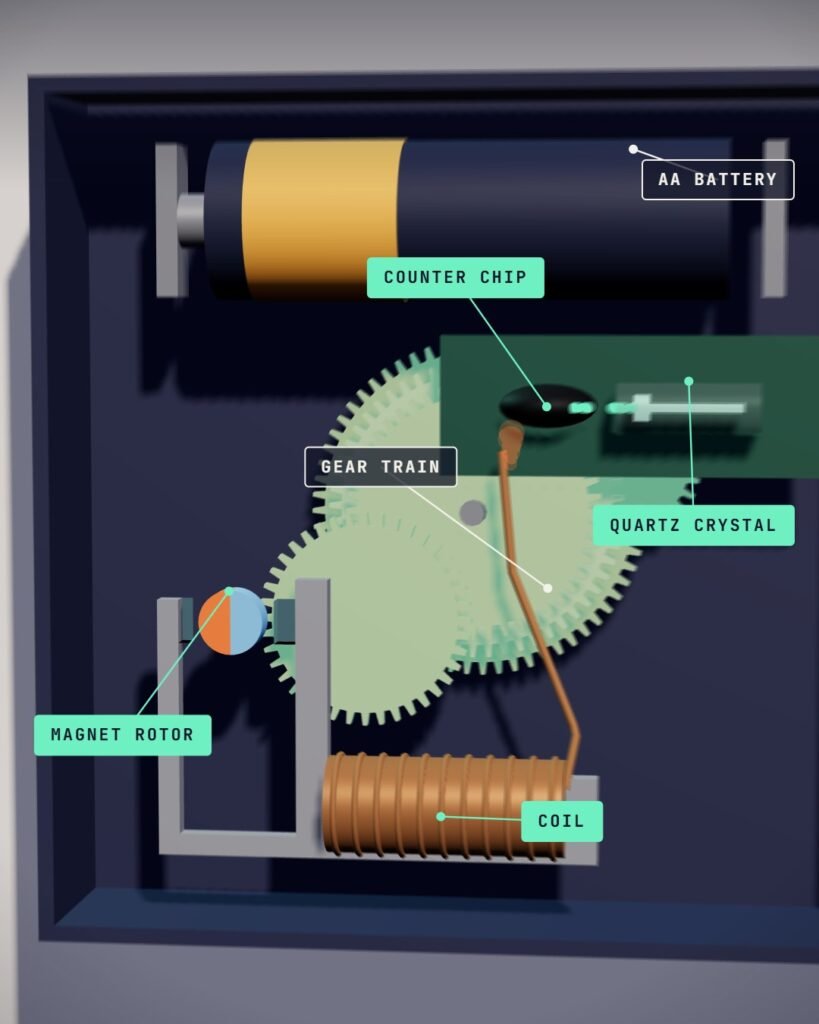
Quartz crystal
A tiny quartz tuning fork in a can. Driven by a small voltage, it vibrates at a steady 32,768 times a second.
Component: Quartz crystalChip
Amplifies the crystal’s signal to keep it vibrating, then halves the rate 15 times to make one pulse per second.
Coil and stator
Each pulse through the coil briefly turns the stator into a magnet, with the polarity reversed every second.
Component: Electric MotorRotor
A small two-pole permanent magnet. Each pulse flips it 180 degrees in the same direction. This step is the tick.
Component: MagnetGear train
Slows the rotor’s half turns so the second hand laps once a minute, then gears down 60 times to the minute hand and 12 times more to the hour hand.
Component: GearHands
Second, minute and hour hands on nested shafts that come through the center of the dial.
Hand-set knob
A wheel on the back of the movement for setting the time without forcing the hands.
Every tick starts with a shaking crystal
Turn a battery wall clock over. Behind the dial sits a small plastic box, the movement, with a slot for one AA battery. That box decides when every second begins and ends, and it does it with a sliver of quartz that vibrates tens of thousands of times a second.
As NIST, the US national measurement lab, explains it, a quartz clock uses a piece of quartz crystal in an electronic circuit, where it vibrates at a steady rate, usually 32,768 times a second. The circuit counts those vibrations and turns every 32,768 of them into a one-second tick. A tiny motor and a set of gears turn each tick into moving hands.
So the clock has three jobs: keep a steady beat, count it, and move the hands.
Squeeze a crystal, get a voltage
Quartz is useful because it is piezoelectric. In 1880, Pierre Curie and his older brother Jacques found that putting pressure on certain crystals created electricity, as APS News recounts. The name comes from piezein, Greek for “squeeze”. Quartz showed one of the strongest effects.
The effect also runs backward. The next year, mathematician Gabriel Lippmann worked out that an electric field should make such a crystal deform. Your clock relies on that reverse effect. NIST’s time and frequency glossary puts it simply: apply a voltage and the crystal expands or contracts; reverse the voltage and the strain reverses. Drive it with a voltage that swings back and forth, and it vibrates.
A tuning fork in a tiny can
The quartz in a clock is cut into a miniature tuning fork and housed in a small can on the circuit board. Crystal maker Raltron, for example, sells 32.768 kHz tuning-fork crystals designed for time-of-day clocks, in a package about 3 by 8 millimeters.
Like a real tuning fork, it has a natural rate at which it rings, set by the cut and size of the crystal. The chip keeps it ringing. NIST describes how: the circuit takes the small voltage from the crystal, amplifies it and feeds it back, topping up each vibration with just enough energy. Quartz oscillators are the most common source of time and frequency signals, NIST says, and billions are made every year.
Counting to 32,768
Why such an odd number? Because 32,768 is 2 multiplied by itself 15 times. A digital circuit can halve a frequency easily: one simple stage puts out one pulse for every two it receives. Chain 15 of those stages, and 32,768 vibrations per second become exactly one pulse per second. That is the division by 32,768 that NIST describes.
A high frequency also keeps small errors small. NIST’s example is a quartz watch whose crystal is off by a tenth of a hertz. It would drift by one second every 327,680 seconds, or roughly 0.26 seconds a day.
The tick: a magnet that flips half a turn
The once-a-second pulse goes to a tiny stepping motor. A Seiko Instruments patent for an analog timepiece lays out the parts: a coil wound on a stator of magnetic material, and a two-pole rotor sitting in a hole in the stator. A Timex patent calls this family the Lavet-type stepping motor, with a bipolar permanent-magnet rotor, the kind that drives the hands through a gear train.
When a pulse flows through the coil, the stator becomes a magnet for a moment and the rotor turns 180 degrees. The next pulse has the opposite polarity, so the rotor turns another half turn in the same direction. That small, sudden step, passed through the gears to the second hand, is the tick you hear.
Some movements also make sure each step happened. The Seiko patent adds a check: it starts with a normal drive pulse and uses a wider, stronger one only when a detection circuit finds that the rotor did not turn.
Not every movement ticks. Clock-movement supplier ClockParts sells continuous-sweep movements, also run on one AA cell, whose second hand glides instead of stepping, so you don’t hear a click every second. At the other extreme, the Timex patent describes a watch motor that steps just once a minute.
From battery to second hand
- Battery. A single AA cell powers the chip and the motor.
- Crystal. The chip keeps the quartz tuning fork vibrating 32,768 times a second.
- Divider. Fifteen halving stages count those vibrations down to one pulse per second.
- Coil. The pulse briefly magnetizes the stator, with the polarity flipped each second.
- Rotor. The little magnet turns half a turn, always in the same direction.
- Gears. A train of small gears slows the rotor’s motion and turns the hands.
The gear ratios are simple arithmetic. The rotor makes half a turn each second, and the second hand goes round once in 60 seconds, so the gears between them slow things down 30 times. The minute hand turns 60 times slower than the second hand, and the hour hand 12 times slower again. Exact tooth counts vary from one movement to another.
How accurate it is, and why temperature matters
NIST lists temperature, humidity, pressure and vibration as changes that can shift a quartz resonator’s frequency, and slow aging of the crystal limits it over the long term.
Temperature is the big one for a tuning-fork crystal. Its frequency follows an upside-down parabola: fastest at a “turnover” temperature, which Raltron’s datasheet puts at 25°C, give or take 5 degrees, and slower whether it gets warmer or colder. With the datasheet’s typical curvature of 0.034 parts per million per degree squared, we calculate that a crystal 20 degrees from its turnover point runs about 14 parts per million slow, roughly 1.2 seconds a day. That is a calculation for the crystal alone, not a measured clock figure.
Each crystal also leaves the factory slightly off its nominal frequency: the standard tolerance for that part is plus or minus 20 parts per million. So a clock hung near a heater or on a cold outside wall can be expected to drift more than the same clock in a steady room.
Clocks that set themselves
Radio-controlled clocks contain a small radio. In the US, it listens to NIST station WWVB, which broadcasts on 60 kHz from near Fort Collins, Colorado. NIST says most decode the signal once a day and keep time with their own quartz oscillator in between. They are often sold as “atomic” clocks, which NIST calls inaccurate: an atomic clock has an atomic oscillator inside, such as cesium or rubidium. A plain battery clock has no radio and relies on its crystal alone.
From a lab bench to every wall
Warren Marrison joined Bell Laboratories in 1925 to work on frequency standards for radio transmission. In 1927, according to the National Inventors Hall of Fame, he divided a quartz crystal’s frequency electronically until it was low enough to drive a synchronous motor. Almost as a side effect, he had built the first quartz crystal clock. By the 1940s, time standard laboratories worldwide had switched from mechanical clocks to quartz.
The IEEE Milestone for the Seiko Quartz-Astron 35SQ, introduced in Tokyo on December 25, 1969, credits a Suwa Seikosha team led by Tsuneya Nakamura. It combined a quartz crystal oscillator, an integrated circuit and a miniature stepping motor to turn the hands, the same three jobs your wall clock does today. It was accurate to within five seconds a month.
Keeping a quartz clock accurate and running
- Try a fresh battery first. Howard Miller says old, exhausted batteries are the main cause of a battery movement misbehaving, and advises brand-new alkaline batteries, installed the right way round.
- Don’t mix batteries. Never mix old with new, or different types. Energizer warns this can cause leakage or rupture.
- Check the contacts and hands. A poor battery connection can cause trouble. If the clock runs slow, make sure the hands don’t rub the dial or glass.
- Set the time with the knob. Howard Miller’s setting guide recommends the hand-set knob. On non-chiming movements you may also push the hour hand forward, but never backward, which can strip the gears.
- Pick a steady spot. Away from heaters and cold walls, the crystal stays nearer the temperature where it keeps its best time.
- Take the battery out for storage. Energizer advises removing batteries from devices that won’t be used for a long time. Alkaline cells contain potassium hydroxide, which MedlinePlus lists as a poisonous ingredient, so a leak is worth avoiding.
If fresh batteries and free hands don’t bring it back, the movement is replaced as a unit. Howard Miller notes that the gears in battery-operated movements can’t be replaced or repaired.
How it works, step by step
Power
A single AA battery supplies the chip and the motor.
Vibrate
The chip keeps the quartz tuning fork ringing 32,768 times a second by amplifying its signal and feeding it back.
Count
Fifteen halving stages divide 32,768 down to exactly one pulse per second.
Pulse
Each pulse flows through the coil and magnetizes the stator, with the polarity flipped every second.
Step
The magnet rotor turns half a turn, always the same way. That is the tick you hear.
Gear down
Gears turn 60 steps into one lap of the second hand, then slow it 60 times for the minute hand and 12 times more for the hour hand.
Myth vs fact
The quartz crystal is what powers the clock.
The battery supplies the energy. The crystal only sets the pace: a small voltage makes it vibrate at a steady rate, and the chip counts those vibrations.
A clock that sets itself is an atomic clock.
A radio-controlled clock has a radio that picks up NIST’s WWVB signal and a quartz crystal that keeps time between updates. NIST says calling it an atomic clock is inaccurate.
A quartz clock keeps perfect time.
Temperature, humidity, pressure, vibration and aging all shift a crystal’s frequency slightly. Tuning-fork crystals run slower when warmer or colder than about 25°C.
If the clock runs slow, the crystal is worn out.
Howard Miller says exhausted batteries are the main cause of a battery movement misbehaving. Hands rubbing the dial or glass can also slow it.
Wall clocks usually run on AA alkaline cells, and alkaline cells can leak. Their contents include potassium hydroxide; if they touch your skin or eyes, MedlinePlus advises washing the area with water for 15 minutes, and the US Poison Help line is 1-800-222-1222. Don’t mix old and new batteries or different types, which Energizer says can cause leakage, and take batteries out of a clock you are storing.
Questions people ask
Why do quartz clocks use 32,768 Hz?
Because 32,768 is 2 to the 15th power. A chain of 15 simple halving stages turns it into exactly one pulse per second, which NIST describes as dividing by 32,768 to make one-second ticks.
How accurate is a quartz wall clock?
It depends on the crystal and where the clock hangs. In NIST’s example, a crystal off by a tenth of a hertz drifts about 0.26 seconds a day. A tuning-fork crystal also runs slower the further it gets from about 25°C, so a steady room helps.
Why do some wall clocks tick and others don’t?
A ticking movement steps the second hand once a second with a stepping motor. A continuous-sweep movement moves the hand smoothly, so there is no click every second.
What battery should I use?
Use the size the clock asks for, usually one AA. Howard Miller advises brand-new alkaline batteries installed the right way round. Don’t mix old and new or different types.
Can I turn the hands backward to set the time?
Use the hand-set knob. Howard Miller says that on non-chiming movements you can also push the hour hand forward, but never backward, which can strip the gears.
Sources
Published by Cut It Open. Checked against every listed source before publishing.
Facts last verified 2026-11-02
Published November 2, 2026 · Updated November 1, 2026