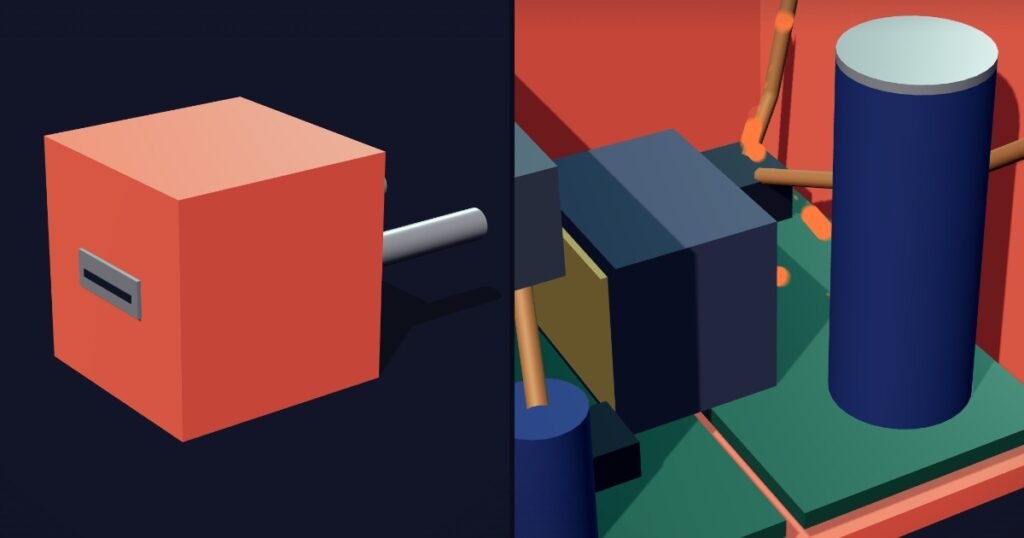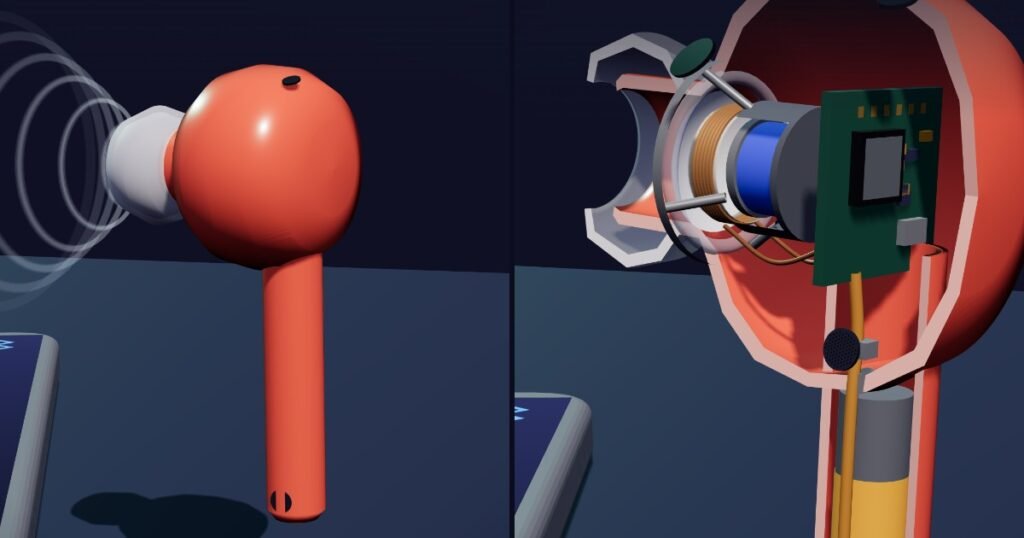
Your phone and its charger talk through the charging coils themselves, with no Bluetooth. The phone switches a small load on and off, and the charger reads the changes in its own coil current as data, at 2 kilobits per second.
Anatomy: what's inside
Transmitter coil
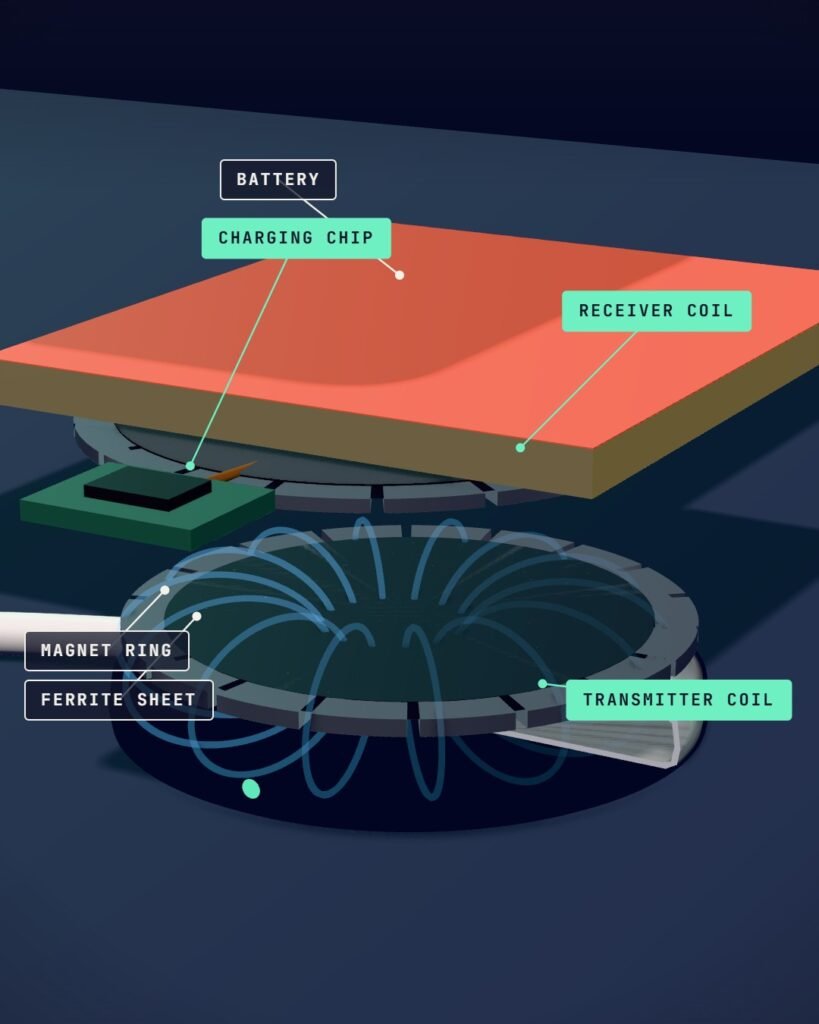
A flat spiral of wire in the pad. Alternating current through it makes the flipping magnetic field.
Component: CoilFerrite sheet
A thin magnetic ceramic layer behind each coil. It steers the field into the gap between the coils and away from other parts.
Inverter and controller
Typically a chip and four transistors that turn the adapter’s direct current into fast alternating current and set how much power flows.
Resonant capacitor
Paired with the transmitter coil to form a tuned circuit that the inverter drives.
Component: CapacitorMagnet ring
In Qi2 and MagSafe chargers, a ring of magnets that snaps the phone into place so the two coils line up.
Component: MagnetReceiver coil
A flat coil behind the phone’s back. The changing field induces an alternating voltage in it.
Component: CoilRectifier and charging chip
Turns the alternating current into steady direct current, regulates it, and sends the phone’s messages back to the charger.
Battery
Stores the energy. The phone asks for more or less power as it charges, and asks the charger to stop at the end.
Component: BatteryNo plug, but still a circuit
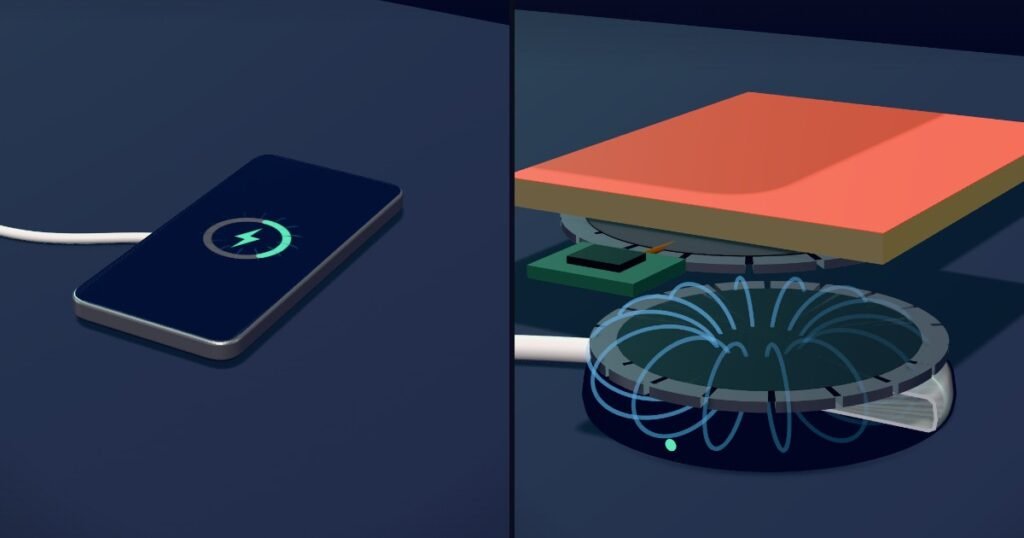
Set your phone on a wireless charger and the battery icon starts filling, with no metal touching metal. The power crosses the gap as a magnetic field, between two flat coils of wire: one in the pad and one behind your phone’s back glass.
A Texas Instruments datasheet calls wireless power transfer an open-cored transformer: a transmitter coil in the charging pad, a receiver coil in the phone. Drive the first coil and the field it makes reaches the second, which produces a voltage of its own.
The rest of the charger finds the phone, lines up the coils, sets the power and stops when something is wrong.
Faraday’s law does the lifting
As HyperPhysics at Georgia State University states it, any change in the magnetic environment of a coil of wire induces a voltage in that coil. The key word is change. A steady magnet on a coil does nothing; a field that keeps reversing keeps pushing.
So the charger feeds its coil alternating current, current that swings back and forth. Each swing builds a magnetic field, collapses it and builds it again the other way. The phone’s coil sits in that flipping field, and an alternating voltage appears across it.
A classic transformer does the same thing with two coils wound on a shared iron core. Here the “core” is a few millimeters of plastic, air and glass. A TI receiver datasheet calls the result effectively an air-core transformer, and describes the two coils as loosely coupled. Only part of one coil’s field passes through the other.
Inside the pad: a fast switch, a coil and a ferrite sheet
A charger takes in direct current from its USB-C adapter, so it has to make the alternating current itself. Infineon’s design guide for a 15-watt Qi transmitter shows how. A controller chip adjusts the input voltage, then four transistors in a full-bridge inverter switch it back and forth. That drives a resonant circuit made of the transmitter coil and a capacitor.
The coil in that design is a flat spiral, 44 mm across with 10 turns, built to dimensions taken from the Qi specification. Under it sits a thin sheet of ferrite, a magnetic ceramic. TI explains that this shielding backs both the transmitter and receiver coils to direct the field into the space between them. Field outside that zone carries no useful power.
How fast the field flips
The Wireless Power Consortium, the industry group behind the Qi standard, lists a 360 kHz operating frequency among the changes in Qi v2.0, the version that added magnets. Test lab Granite River Labs explains that 360 kHz is the frequency of the magnetic profile, while the basic and extended profiles run between 87 and 205 kHz. That is 360,000 back-and-forth cycles every second.
Pads without the magnetic profile work lower. TI’s 5-watt transmitter chip regulates power by moving its frequency between 110 kHz and 205 kHz: the further from resonance, the less power gets through. Infineon’s 15-watt board does it the other way, holding the switching frequency at 127.7 kHz and changing the voltage instead.
Inside the phone: from wobble to steady charge
What arrives in the phone’s coil is alternating, but a battery needs current that flows one way. The receiver chip handles that. TI’s example receiver uses a synchronous rectifier for AC-to-DC conversion, then regulates the output before passing it on to the phone’s charging circuit. Here is the whole path:
- Wall adapter. Mains power becomes low-voltage direct current for the pad.
- Charger chip and transistors. They set the voltage and chop it into fast alternating current.
- Transmitter coil. The current makes a flipping magnetic field, steered upward by the ferrite.
- The gap. The field passes through the pad’s top, any case and the phone’s back.
- Receiver coil. The changing field induces an alternating voltage in the phone’s coil.
- Rectifier and charging chip. Alternating current becomes steady direct current at the voltage the battery needs.
- Battery, with feedback. The battery fills while the phone keeps telling the charger to raise or lower power, and finally to stop.
The phone does the talking
The charger can’t see the battery, so the phone runs the show. According to TI’s receiver datasheet, the transmitter coil stays off most of the time and wakes up now and then to check whether a receiver is present. When a phone answers, it identifies itself, and power starts flowing.
The messages ride on the power link itself, with no Bluetooth involved. The phone switches a small load in and out across its coil. That changes the current in the charger’s coil, and the charger decodes the pattern as data, at 2 kilobits per second. The packets include identification, control messages asking for more or less power, and end-power messages when charging should stop. Higher-power Qi chargers can also reply: GRL says the extended profile introduced two-way communication, and Infineon’s 15-watt controller includes an FSK modulator, which signals by shifting the frequency slightly.
Why the magnets matter
TI’s transmitter datasheet is blunt about it: the receiver and transmitter coils must be aligned for best coupling and efficient power transfer, and the smaller the gap, the better. Slide the phone off-center and less of the field passes through its coil.
Researchers at the University of Warwick measured what that costs on one phone model. Misaligned, the charging base drew up to 11 W instead of 9.5 W, because the system raised transmitter power to compensate, and the base ran about 2 °C warmer.
Qi v2.0 added magnetic attachment and alignment of charger and phone. The WPC says this Magnetic Power Profile is based on MagSafe technology contributed by Apple. Apple’s accessory design guidelines require a MagSafe accessory’s magnet ring to self-align with the iPhone’s within 1.55 mm, using N48H neodymium magnets.
How many watts, really
The first Qi version, in July 2010, delivered 5 watts. According to the WPC’s knowledge base, Qi2 launched in 2023 with 15 watts, and Qi2 25W followed in July 2025. Apple says its current MagSafe Charger models deliver up to 25W of peak power with a 30W or larger adapter on supported iPhones, and that the actual power varies with the iPhone model, the adapter and conditions.
Infineon notes that the coil loses energy in its windings and in the ferrite, and the electronics take their share too. Its 15-watt reference board reaches a peak system efficiency of more than 83 percent with a test receiver. That is one lab setup, not your phone from wall to battery.
Metal, cards and heat
A coin or key in the gap acts like a tiny third coil. The field induces currents in it, and it heats up. Chargers guard against this with foreign object detection. TI’s transmitter compares the power it sends with the power the phone reports receiving. If too much goes missing, presumed lost in metal, it flags a fault and halts power transfer. TI suggests a default threshold of 400 mW, tuned with standard test objects. Metal that soaks up less power than the threshold may not trip it, so detection is a safety net, not a guarantee.
That safety net is part of what certification tests. A WPC brochure from around 2017 reports lab tests on uncertified chargers that found temperatures of up to 205°F (96°C) when a metal object, such as a coin, sat between charger and phone. The WPC advises looking for the Qi logo and checking its certified product database.
Cards are a different risk. Apple warns against putting credit cards, security badges, passports or key fobs between an iPhone and a MagSafe Charger, because this might damage their magnetic strips or RFID chips. Some warmth is expected: Apple says the phone or charger might get slightly warmer, and if the battery gets too warm, software might limit charging above 80 percent.
Getting a good charge
- Center the phone. On a pad without magnets, line the phone up over the coil. Off-center, the pad usually has to push more power to make up for it.
- Plug in first. Apple says to connect the MagSafe Charger to power before placing the iPhone on it.
- Clear the gap. Keep coins and keys off the pad, and take cards out of a wallet case before charging.
- Watch the case. A thick case, or one with metal in it, puts distance or metal in the field. Apple’s guidelines cap MagSafe cases at 2.1 mm thick.
- Expect some warmth. If the battery gets too warm, Apple says software might limit charging above 80 percent. For the longest battery life, the Warwick team still recommends a cable.
How it works, step by step
Ping
The charger’s coil stays off most of the time and briefly wakes up to check whether a phone is on the pad.
Identify
The phone answers with identification and setup messages, and the charger starts sending power.
Flip the field
Transistors drive alternating current through the transmitter coil, making a magnetic field that reverses again and again.
Induce
The field passes through the gap into the phone’s coil and induces an alternating voltage there.
Rectify
A rectifier turns that into direct current, and the charging chip feeds it to the battery.
Adjust and stop
The phone keeps asking for more or less power by switching a load on its coil, and sends an end-power message when charging should stop.
Myth vs fact
Wireless charging beams power through the air, like Wi-Fi.
It works by magnetic induction between two coils that have to be close and lined up. TI notes that the smaller the gap, the better the coupling, and field outside the coupled zone carries no useful power.
The magnets are what charge the phone.
The magnets only hold the phone in place and line up the coils. The power travels through the coils’ alternating field; a steady magnet induces no voltage at all.
A 25-watt charger always charges at 25 watts.
That figure is a peak. Apple says the MagSafe Charger delivers up to 25W of peak power, and that actual power varies with the iPhone model, the adapter and conditions. Plain Qi2 was 15 watts.
The charger shuts off whenever any metal is near.
Foreign object detection compares the power sent with the power the phone reports receiving, and halts charging if too much goes missing. A piece of metal that absorbs less power than the detection threshold may not trip it, so keep metal off the pad.
Keep coins, keys and other metal off the pad. Metal in the field heats up, and a piece that absorbs less power than the charger’s detection threshold may not trigger its shutoff. Apple warns against putting credit cards, badges, passports or key fobs between phone and charger, because this might damage magnetic strips or RFID chips. Choose a Qi certified charger: the WPC says only certified products may legally carry the Qi logo, and a WPC brochure from around 2017 reports high temperatures in lab tests of uncertified chargers with metal in the gap.
Questions people ask
Does wireless charging work through a phone case?
Usually, if the case is thin and has no metal in it. TI notes that the smaller the space between the coils, the better the coupling, and Apple’s guidelines cap MagSafe cases at 2.1 mm thick. Take cards out of a wallet case before charging.
What is the difference between Qi, Qi2 and MagSafe?
Qi is the wireless charging standard from the Wireless Power Consortium. Qi2 added a Magnetic Power Profile with magnets that line up phone and charger; the WPC says it is based on MagSafe technology contributed by Apple. MagSafe is Apple’s own magnetic charging system for iPhone.
How fast is wireless charging?
It depends on the charger, the phone and the adapter. The WPC says Qi2 enabled 15 watts and Qi2 25W launched in July 2025. Apple says its current MagSafe Charger models reach up to 25W of peak power with a 30W or larger adapter on supported iPhones.
Why does my phone get warm on a wireless charger?
Some energy is lost in the coils, the ferrite and the electronics, and it ends up as heat. Apple says the phone or charger might get slightly warmer, and if the battery gets too warm, software might limit charging above 80 percent. When a phone is misaligned, chargers typically push more power to make up for it, which adds heat.
Is wireless charging bad for my battery?
Heat is the concern. In a University of Warwick study of one phone model, the phone ran warmer on an inductive charger than on a cable, and the researchers concluded that this will likely shorten battery life. They still recommend a cable if the longest battery life is your priority.
Sources
Published by Cut It Open. Checked against every listed source before publishing.
Facts last verified 2026-11-15
Published November 17, 2026 · Updated November 15, 2026