Bosch says the first electronic airbag control unit went into production in December 1980 and launched in the Mercedes-Benz S-Class. Its engineers had been working on it since 1977.
Anatomy: what's inside
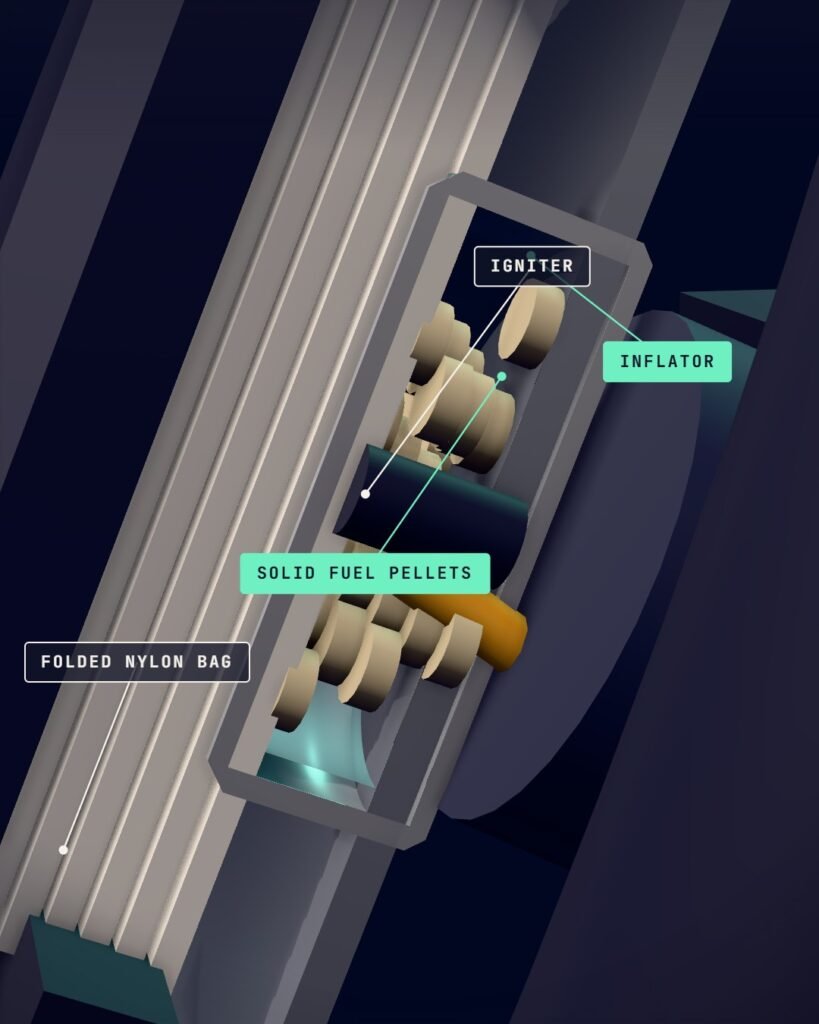
Crash sensors
Measure how fast the car is slowing down. They sit in the front of the car, in the passenger compartment, or both; modern units also use yaw-rate and pressure sensors.
Component: SensorControl unit
Runs the trigger software that decides within milliseconds whether to fire, and checks the system each time you start the car, lighting a warning lamp if something is wrong.
Reserve capacitors
Store enough electrical energy to fire the airbag even if the crash cuts off the car’s battery.
Component: CapacitorInitiator
An electrically triggered igniter, which Autoliv compares to a spark plug in design. It lights the propellant when the signal arrives.
Inflator
The metal canister in the module that holds the propellant and turns it into a burst of gas. Some are pyrotechnic; hybrids add stored compressed gas.
Gas generant
Solid propellant that burns at a controlled rate into gas. Older driver inflators mostly used sodium azide; many newer ones use non-azide fuels such as guanidine nitrate with an oxidizer.
Filter
Sits inside the inflator, cools the hot gas and catches particles before the gas reaches the bag.
Fabric bag with vents and tethers
A folded fabric bag, often nylon or a nylon variant, averaging about 56 liters for 1990s driver bags. Tethers shape it; vents let gas out so it goes soft as you sink in.
Module cover
The steering wheel’s center cover. It splits along a built-in tear pattern (in 1990s cars, usually H, U, I or horizontal), so the bag can get out.
Faster than a blink, on purpose
In a frontal crash, the car stops in a fraction of a second, but your body keeps going. A 2002 air bag brochure from the safety group ACTS, distributed in cooperation with NHTSA, explains that unbelted occupants keep moving at the car’s original speed until its interior stops them. The airbag puts a cushion there first.
It has almost no time. NHTSA says the bag inflates within the blink of an eye, in less than 1/20th of a second. The brochure counts from the onset of the crash and puts the whole process at about 1/20th of a second, sensing included. This article follows the driver’s frontal airbag.
What’s packed into the steering wheel hub
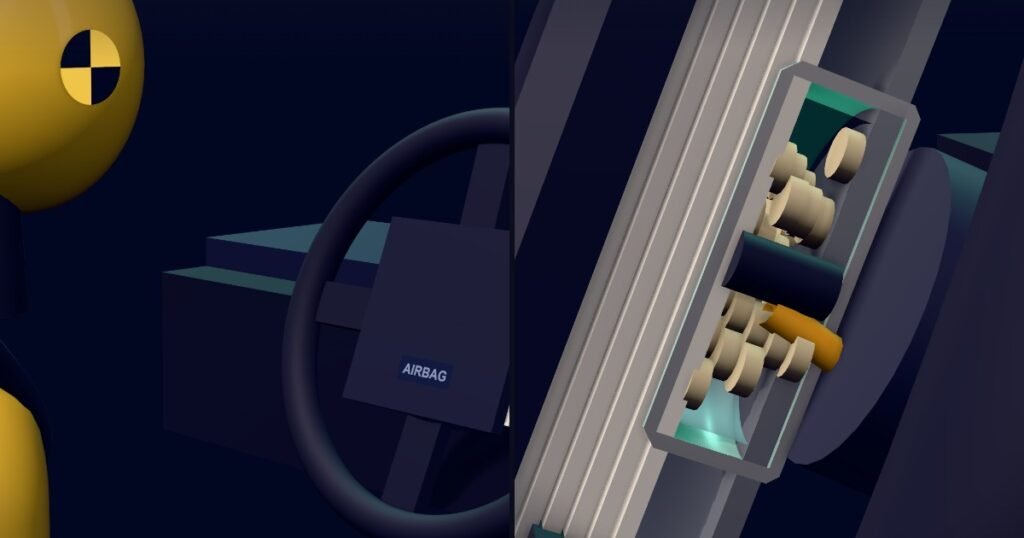
The brochure describes three parts: an air bag module, crash sensors and a diagnostic unit. The driver’s module holds an inflator and a lightweight fabric bag that, fully inflated, is roughly the diameter of a large beach ball.
A 1999 NHTSA report, Air Bag Technology in Light Passenger Vehicles, covers model years 1990 to 1998. Driver bags averaged about 56 liters. About 31 percent were nylon, and the report says most of the other materials were nylon variants or other fabrics. By 1998 most vehicles had two or more tethers, internal straps that shape the bag. The cover splits along a tear pattern; for that era the report lists H, U, I and horizontal shapes. Designs today vary by car.
How the car knows it’s crashing
The brochure says crash sensors measure deceleration, the rate at which the vehicle slows down, from the front of the car, the passenger compartment, or both. Hard braking won’t trigger them: even the severest braking produces only a small fraction of the deceleration needed.
In the early 1990s, the NHTSA report found, most were electromechanical spring-mass sensors; by 1998 the trend was toward electronic ones. Today, Bosch says, a state-of-the-art control unit uses internal and external acceleration, yaw-rate and pressure sensors.
The system must also work if the crash cuts the battery cable. The brochure says most diagnostic units store enough electrical energy to deploy the airbag if the battery is destroyed early in a crash. A 1995 Delco Electronics patent shows one way: large reserve capacitors that hold enough energy to run the firing circuit and the deployment circuit.
What “moderate to severe” really means
NHTSA says frontal airbags are generally designed to deploy in moderate to severe frontal or near-frontal crashes, equivalent to hitting a solid, fixed barrier at 8 to 14 mph or higher. That is a measure of crash severity, not a speedometer reading. NHTSA says it equals striking a parked car of similar size at about 16 to 28 mph or higher; the brochure explains that the parked car absorbs some of the energy and is pushed. Because real crashes happen at angles, the brochure adds, the speed needed can be much higher. NHTSA notes airbags may also deploy in a minor crash.
The Insurance Institute for Highway Safety says a front airbag typically deploys for an unbelted occupant at the equivalent of a rigid wall at 10 to 12 mph, while most use a higher threshold, about 16 mph, for belted occupants.
The crash, millisecond by millisecond
- Sense. The instant a crash begins, IIHS says, sensors start to measure how severe it is.
- Decide. The control unit’s software judges whether the crash calls for the airbag. Bosch says its trigger algorithm does this in about ten milliseconds.
- Ignite. A signal reaches the inflator. An electrically triggered initiator, which Autoliv compares to a spark plug in design, lights the propellant.
- Make gas. The solid propellant burns into gas, which passes through filters that cool it and catch particles.
- Fill the bag. The bag bursts through the cover. Bosch says it is fully inflated within 30 milliseconds; the 1999 report’s 1990s data averaged about 33 milliseconds for driver bags.
- Vent. Deflation begins at once, the brochure says, as gas escapes through vents in the fabric.
Bosch’s two figures fit inside NHTSA’s “less than 1/20th of a second” (50 milliseconds), but Bosch doesn’t say exactly when its 30 milliseconds start, so treat the list as a rough guide. The bag comes out hard: the brochure says generally at over 100 mph. Distance matters.
What burns inside the inflator
Autoliv’s pyrotechnic inflators hold a core of solid gas generant that burns at a controlled rate into a harmless nitrogen-based gas. The brochure says some airbags use nitrogen and others argon, and that the gases are harmless. Autoliv also makes hybrid inflators that add stored compressed gas.
The fuel differs by maker and era. An Autoliv patent from 2003 says gas generants were previously most typically based on sodium azide, and that non-azide fuels are generally less toxic to make and use. It calls guanidine nitrate widely used in the industry, and pairs such fuels with an oxidizer, such as basic copper nitrate, because a fuel alone lacks the oxygen to burn completely. NHTSA’s 1999 report still found sodium azide by far the most common agent in 1998 driver modules.
Why it catches you, then goes soft
A bag that stayed fully pressurized would act more like a wall than a cushion. Because gas leaves through the vents right away, the bag gives way as your chest and head sink into it. The brochure says airbags help reduce the risk of serious injury by spreading crash forces more evenly across your body. The 1999 report credits changes in vent sizes, among others, with making airbags themselves safer.
An airbag works only once. NHTSA says to replace a used one right away, only at an authorized repair center, and before you drive again.
When the inflator itself is the danger
A defective inflator can explode. NHTSA says about 67 million Takata airbags have been recalled because they can explode when deployed, and that long-term exposure to high heat and humidity can cause it. NHTSA has confirmed 28 deaths in the United States, and it has issued Do Not Drive warnings for some vehicles at far higher risk. Its FAQ names 2006 Ford Ranger and Mazda B-Series trucks, some of whose owners Ford and Mazda advise not to drive, and certain 2001–2003 Honda and Acura models, which should be driven only to the dealer for repair.
Replacement parts can be dangerous too. NHTSA’s page on deadly air bag replacements says 11 people died and three were severely injured in 14 crashes involving replacement driver inflators marked “DTN60DB”. A car with one should not be driven until it gets genuine parts. If a used car has had an airbag deployment, have a certified technician inspect it; NHTSA says not to do it yourself. To check your car:
- Find your VIN. NHTSA’s recall page says the 17-character number is on the lower left of the windshield and on your registration card.
- Search it on nhtsa.gov/recalls. The VIN search shows unrepaired recalls from the manufacturers it covers; very new recalls may take time to appear.
- Check twice a year. NHTSA recommends it, because new recalls keep being added.
- Get the free fix. Contact your dealer as soon as possible.
- If your car has a Do Not Drive warning, don’t drive it. Contact the dealer and follow the manufacturer’s instructions for the repair.
- Don’t disable the airbag while you wait. NHTSA says it is much more likely to protect you than to cause harm.
Leave the module itself alone; an undeployed airbag still holds its propellant. Tesla’s service manual, for example, says only trained professionals should service the system and warns against dismantling a module before it has deployed.
Sitting safely with an airbag
NHTSA says airbags are designed to work with seat belts, not replace them. IIHS cites an NHTSA estimate that an airbag plus a lap and shoulder belt reduces the risk of death in frontal crashes by 61 percent.
- Always wear your belt. The brochure notes it keeps you in position for the bag and keeps holding you in a second impact.
- Keep at least 10 inches. NHTSA recommends at least 10 inches (25 cm) between the center of your breastbone and the center of the steering wheel. Move the seat back or tilt the wheel down, while still reaching the pedals comfortably.
- Kids under 13 ride in the back, even in cars with advanced airbags, NHTSA says.
- Never put a rear-facing car seat in front of an active airbag. The brochure explains it puts the baby’s head close to the module.
- Keep the cover clear. The brochure warns that objects on or near a module can be thrown with great force.
Federal Motor Vehicle Safety Standard 208, which has required front-seat airbags in passenger cars made since September 1, 1997, also requires a sun visor warning label. One line reads: “The BACK SEAT is the SAFEST place for children.”
How it works, step by step
Sense
The instant a crash begins, sensors start measuring how sharply the car is slowing down.
Decide
The control unit’s software judges whether the crash is serious enough. Bosch says its algorithm takes about ten milliseconds.
Ignite
A signal reaches the inflator, and an electrically triggered initiator lights the solid propellant.
Make gas
The propellant burns into a harmless gas, which filters cool and clean on the way out of the inflator.
Fill the bag
The gas bursts the bag through the cover. Bosch says it is fully inflated within 30 milliseconds; NHTSA puts the whole process at under 1/20 of a second.
Vent
Gas escapes through vents in the fabric right away, so the bag gives way as your body presses into it.
Myth vs fact
With airbags, you don’t need a seat belt.
NHTSA says airbags are designed to work with seat belts, not replace them. IIHS cites an NHTSA estimate that an airbag plus a lap and shoulder belt cuts the risk of death in frontal crashes by 61 percent.
Slamming on the brakes can set off the airbag.
Airbags are not designed to deploy in sudden braking. The NHTSA-distributed air bag brochure says even the severest braking produces only a small fraction of the deceleration needed.
A frontal airbag fires whenever you hit something at 8 to 14 mph.
That range is a solid-barrier equivalent, a measure of crash severity rather than a speed that guarantees deployment. NHTSA says it equals hitting a parked car of similar size at about 16 to 28 mph or higher, and the brochure notes real-world angled crashes can need more. NHTSA adds that bags may also deploy in a minor crash.
If your airbag is under recall, it’s safer to disable it until it’s fixed.
NHTSA says no. A recalled airbag is much more likely to protect you than to cause harm, while a disabled one gives no protection at all. Get the free recall repair as soon as possible.
Airbags work with seat belts, not instead of them: always buckle up and keep at least 10 inches between your breastbone and the center of the steering wheel, as NHTSA recommends. Children under 13 belong in the back seat, and a rear-facing car seat must never go in front of an active airbag. Check your VIN for open recalls at nhtsa.gov/recalls; defective Takata inflators have exploded and killed people, and if your car has a Do Not Drive warning, don’t drive it. If a used car has had an airbag replaced, have a certified technician check that the inflator is genuine. Never cut into, take apart or test an airbag module yourself: service manuals such as Tesla’s reserve that work for trained technicians, and NHTSA warns that tampering can set the airbag off.
Questions people ask
How fast does an airbag inflate?
NHTSA says an airbag inflates in less than 1/20 of a second, faster than the blink of an eye. Bosch says the bag itself is fully inflated within 30 milliseconds. The NHTSA-distributed air bag brochure says it generally leaves the hub at over 100 mph, which is why you should sit at least 10 inches back.
What gas is inside an airbag?
A brochure distributed with NHTSA says some airbags use nitrogen and others argon, and that the gases are harmless. In a pyrotechnic inflator, Autoliv says, a solid propellant burns into a nitrogen-based gas; hybrid inflators also release stored compressed gas. The exact chemistry differs by maker and era.
What is the powder after an airbag goes off?
The NHTSA-distributed air bag brochure says it is mostly cornstarch or talcum powder used to lubricate the bag. Small amounts of sodium hydroxide may be present at first and can cause minor irritation to the eyes or open wounds. Some people with asthma may have an attack from the dust; the brochure says they should treat themselves as their doctor advised, then seek medical treatment right away.
Can an airbag be reused after it deploys?
No. Airbags deploy only once. NHTSA says to replace a used airbag right away, only at an authorized repair center, and before you drive the vehicle again.
How do I check if my airbag is recalled?
Find your 17-character VIN on the lower left of the windshield or on your registration card, and enter it at nhtsa.gov/recalls. The search shows unrepaired recalls from the manufacturers it covers, and very new recalls may take time to appear, so NHTSA recommends checking at least twice a year. If there is an open recall, contact your dealer; the repair is free. If your car has a Do Not Drive warning, don’t drive it.
Sources
Published by Cut It Open. Checked against every listed source before publishing.
Facts last verified 2026-11-15
Published November 16, 2026 · Updated November 15, 2026