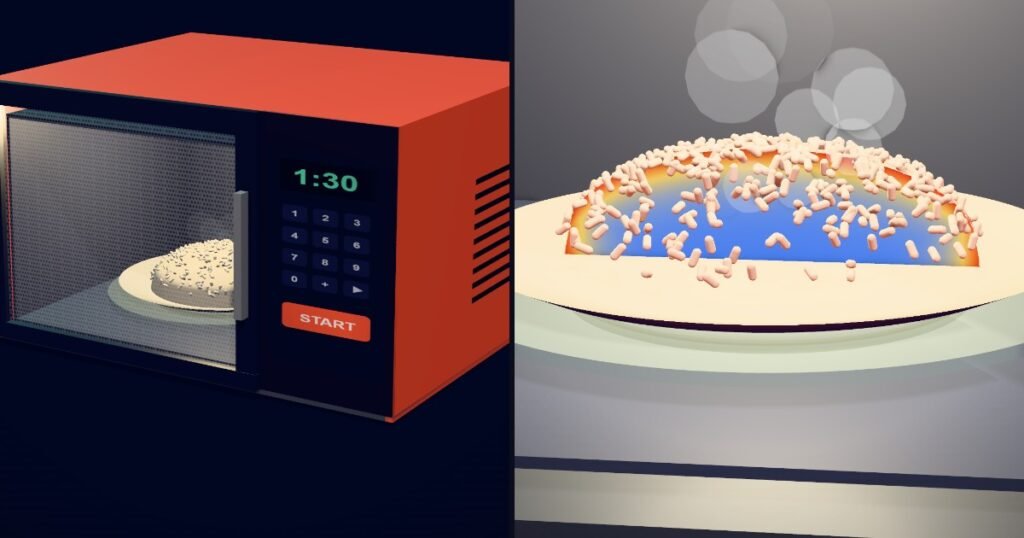
You can see your food through the door, but the microwaves can’t get out. The holes in the door’s metal screen are about 1 millimeter across, while the waves are about 12 centimeters long, roughly 120 times bigger. Visible light is far smaller than the holes, so it passes straight through.
Anatomy: what's inside
High-voltage transformer
Steps up the household line voltage to the high voltage the magnetron needs.
Component: TransformerHigh-voltage capacitor and diode
The capacitor charges through the diode on one half of each AC cycle and releases it on the next, boosting the power fed to the magnetron.
Component: CapacitorMagnetron
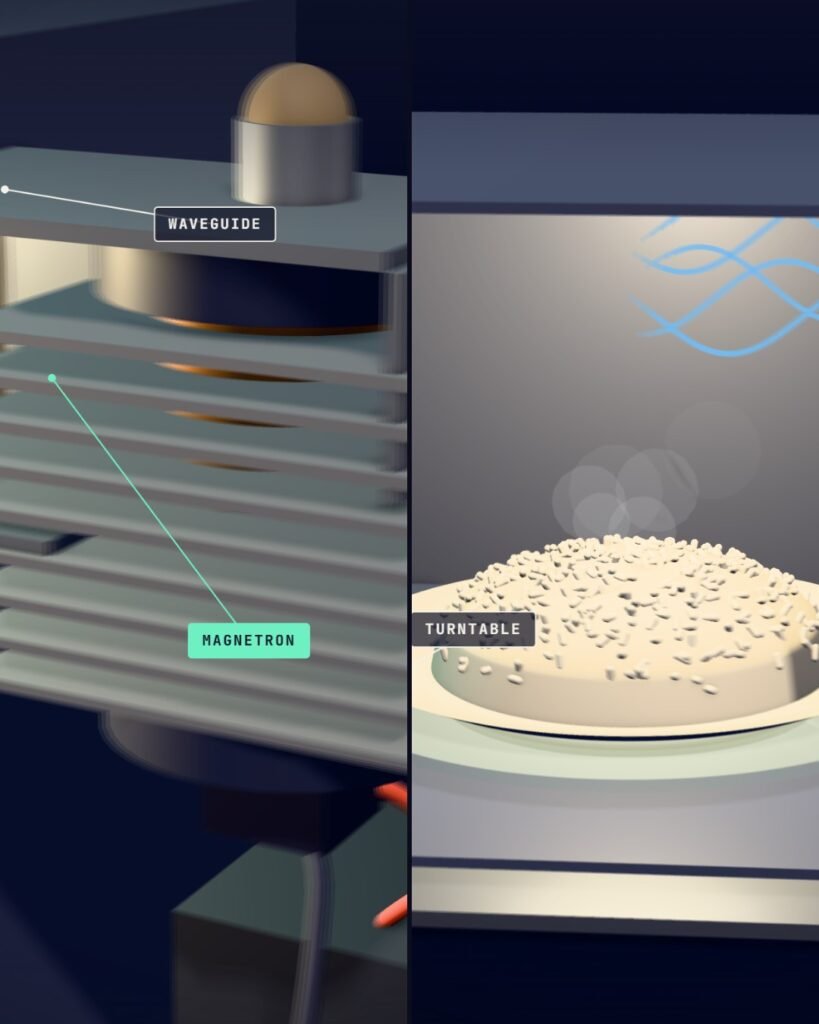
The vacuum tube that turns high-voltage power into microwaves. One example tube delivers 1,030 watts at 4.35 kilovolts.
Magnetron magnets
Permanent ferrite magnets that bend the electrons’ path inside the magnetron so they sweep past the anode’s cavities.
Component: MagnetWaveguide
A rectangular metal channel that leads the microwaves from the magnetron into the cooking cavity.
Cooking cavity
The metal box that holds the food. Its walls reflect the waves, which overlap into a pattern of hot and cold spots.
Turntable and motor
A small motor turns the tray so food moves through strong and weak spots. It evens heating around the circle, not from center to edge.
Component: Electric MotorCooling fan
A motor-driven fan blows air over the magnetron, which needs forced-air cooling, and over the transformer.
Component: Electric MotorDoor screen and interlocks
A metal screen with holes about 1 mm across keeps the waves in. At least two interlocks stop the oven when the door is opened.
Hot edges, cold middle
You heat a bowl of leftovers for two minutes. The rim is scalding and the center is still cold. Nothing is broken. That pattern is built into the way a microwave oven works, and the USDA warns that microwave ovens can cook unevenly and leave “cold spots” where harmful bacteria can survive.
The short version: the oven fills a metal box with radio waves that food absorbs very well. Food soaks them up so well that most of the energy is spent near the surface, and the middle has to wait for heat to travel inward the slow way, by conduction.
From the wall socket to your food
A microwave oven is a chain that turns household power into waves, and waves into heat. Follow the energy:
- Wall power. The oven plugs into an ordinary AC outlet.
- High-voltage transformer and capacitor. A Litton Systems power-supply patent describes a transformer that steps up the line voltage to the high voltage the magnetron needs, plus a capacitor that charges through a diode on one half of each AC cycle and adds that charge on the next.
- Magnetron. This vacuum tube turns that power into microwaves. One example, Toshiba’s 2M248, runs at 4.35 kilovolts and 330 milliamps and delivers 1,030 watts, which its datasheet puts at 71.8 percent efficiency.
- Waveguide. A rectangular metal channel leads the waves from the magnetron into the cooking cavity.
- Cavity. The metal box reflects the waves back and forth.
- Food. Water and dissolved salts in the food absorb the waves and heat up.
Inside the magnetron, electrons stream from a hot filament toward the anode. Permanent magnets bend their path so they sweep past small cavities in the anode, a little like air blown across a bottle makes it whistle. The Toshiba tube uses ferrite magnets and needs forced-air cooling. In the Litton design, a fan motor blows air over the magnetron and transformers.
What 2.45 gigahertz does to water
Modern ovens operate at 2,450 megahertz, or 2.45 gigahertz, according to Georgia State University’s HyperPhysics. That is one of the bands the FCC sets aside for industrial, scientific and medical equipment: 2,450 MHz, give or take 50 MHz. Real tubes sit near that center. The Toshiba tube is rated at 2,460 MHz, plus or minus 10.
At that frequency, the electric field flips direction billions of times a second. A water molecule has a slightly positive end and a slightly negative end, so the field keeps tugging it around. A peer-reviewed review by Juming Tang of Washington State University names the two main ways food takes up the energy: the rotation of water molecules, and the movement of dissolved salts, or ions. That motion is passed on through countless collisions and becomes heat. Physicists call it dielectric heating.
The FDA notes that microwaves pass through glass, paper and plastic and are absorbed by food. That’s why a microwave-safe plate isn’t heated by the waves. It only warms up from the hot food sitting on it. Ice, by contrast, absorbs poorly because its molecules are locked in place, Tang notes, which is one reason frozen food heats so patchily.
How far the waves get into food
Here is the real reason for the cold middle. Every layer of food takes some of the waves’ power, so they fade fast. Scientists measure this as a penetration depth: the distance at which about 63 percent of the power has been absorbed.
That depth is not one fixed number. HyperPhysics gives about 1.4 centimeters for water at 25 °C. Tang’s table of foods at 2,450 MHz lists 3.8 millimeters for cooked ham and 9.9 millimeters for cooked beef, and he notes that penetration depths are small in foods with added salt. Depth can also shrink as food heats up. For salted mashed potatoes, it falls from 9.0 millimeters at 20 °C to 5.6 millimeters at 80 °C.
So in everyday leftovers, the waves do most of their work within a few millimeters to about a centimeter and a half of the surface. A Penn State food-safety specialist put it plainly: most of the energy is absorbed just below the surface. The FDA adds that in thick foods, the inside is cooked mainly by heat conducted from the hot outer layers. That takes time.
Why corners and edges heat first
In a 2023 study in the journal Foods, engineers at Northeast Agricultural University in China reheated rice in a rectangular lunch box. They found hot spots at the corners and cold spots in the center. The corners collected energy through the sides, the top and the bottom. The waves faded before they reached the center, because the penetration depth was shorter than the distance from edge to center.
Small round foods can do the opposite. Tang notes that in a sphere less than about 2.5 to 3 times the penetration depth across, the waves bend toward the center and can heat it hardest. Shape, size and salt all change the pattern.
Hot and cold spots from bouncing waves
The box adds a second kind of unevenness. Waves bounce off the six metal walls and overlap with the waves still arriving. Tang explains that these form standing waves, with strong and weak points a quarter wavelength apart, and those create hot and cold spots in food. The wavelength is about 12 centimeters, according to HyperPhysics, so the strong and weak points are only a few centimeters apart. Penn State’s specialist said cold spots can sit an inch or so from heated spots.
The pattern is hard to predict. Tang points out that a home magnetron doesn’t produce exactly one frequency, and that its peak frequency even shifts with the size and position of the food.
Turntables were installed to deal with cold spots, Penn State says. But an LG Electronics patent notes that a turntable evens out heating around the circle, not from the center to the edge. Other designs use a rotating stirrer to scatter the waves.
Standing time does real work
When the timer beeps, the inside of a thick portion is still catching up. Heat keeps flowing from the hot outer layers toward the cooler middle. NDSU Extension says standing time allows microwaved food to finish cooking and calls it a critical step for safety.
Lower power helps for the same reason. The USDA explains that in a standard oven, below full power the magnetron cycles off and on, so medium (50 percent) power makes microwaves half the time. Siemens notes that inverter models lower the power continuously instead. The USDA recommends medium power for large cuts of meat, because it lets heat reach the center without overcooking the outer areas.
How to heat leftovers evenly and safely
- Spread it out and cover it. The USDA advises arranging food evenly in a covered dish. Vent the lid, and don’t let plastic wrap touch the food.
- Stir or turn it halfway. Even with a turntable, the USDA says it’s still helpful to stir and turn food top to bottom.
- Let it stand, then check. Allow standing time, then use a food thermometer in several places. The USDA’s target for reheated leftovers is 165 °F (74 °C).
- Use containers made for the microwave. The USDA rules out margarine tubs, foam containers, metal pans and china with metallic trim.
- Don’t run it empty. The FDA says some ovens should not be operated empty, so check your manual.
- Watch plain water. Water heated alone in a clean cup can superheat and erupt. The FDA says to keep to the manual’s heating times; adding instant coffee or sugar before heating greatly reduces the risk.
What keeps the waves in the box
The door window is covered by a metal screen with holes about 1 millimeter across. HyperPhysics explains that the waves are about 120 times larger than the holes, so they can’t get out, while visible light passes through easily.
The door is guarded too. The federal microwave oven standard requires at least two safety interlocks, plus a monitor that disables the oven if they fail. It caps leakage at 1 milliwatt per square centimeter, measured 5 centimeters from the surface, before sale, and 5 milliwatts after that. The FDA says this limit is far below the level known to harm people, and that microwaves don’t make food radioactive.
Damage is what matters. The FDA says there is little cause for concern unless the door hinges, latch or seals are damaged. Don’t use an oven whose door doesn’t close firmly or is bent or warped, and stop using one that keeps running with the door open.
How it works, step by step
Step up
A transformer steps household voltage up to the high voltage the magnetron needs, and a capacitor and diode boost the power it delivers.
Generate
The magnetron turns that high-voltage power into microwaves at about 2.45 gigahertz.
Guide
A rectangular metal waveguide carries the waves from the magnetron into the cooking cavity.
Bounce
The waves reflect off the metal walls and overlap, forming hot and cold spots. The turntable moves food through them.
Absorb
Water and dissolved salts near the food’s surface absorb the waves and heat up. Most of the energy is used within a few millimeters to about a centimeter and a half.
Spread
Heat conducts inward from the hot outer layers. Stirring and standing time give the middle a chance to catch up.
Myth vs fact
Microwaves cook food from the inside out.
The FDA says that in thick foods, the outer layers are heated mainly by microwaves, and the inside mainly by heat conducted from those hot outer layers.
Ovens use 2.45 GHz because it is water’s resonant frequency.
Water’s resonance at room temperature is near 20,000 MHz, about eight times higher. 2,450 MHz is a band the FCC sets aside for industrial, scientific and medical equipment, and the heating is dielectric, not resonant.
Microwaving makes food radioactive.
Microwaves are non-ionizing radiation. The FDA says the energy is changed to heat as food absorbs it and does not make food radioactive.
If the oven has a turntable, you don’t need to stir.
A turntable evens heating around the circle but not from the center to the edge. The USDA says it’s still helpful to stir and turn food top to bottom.
Don’t use a microwave oven if the door doesn’t close firmly or is bent, warped or otherwise damaged, and stop using one that keeps running with the door open. Damaged hinges, latches or seals are the main leakage risk; federal rules cap leakage at 5 mW/cm² about 2 inches from the oven over its lifetime. Water heated alone in a clean cup can superheat and erupt: don’t exceed the manual’s heating times, and add instant coffee or sugar before heating. Some ovens should not be run empty; check your manual. Keep metal pans, dishes with metallic trim and food completely wrapped in foil out of the oven (use small foil shields only if your manual allows), and turn the oven off at once if you see sparks. After reheating, let food stand, then check it reaches 165 °F with a food thermometer.
Questions people ask
Why is my food hot at the edges and cold in the middle?
Microwaves fade as food absorbs them, so most of the energy lands within a few millimeters to about a centimeter and a half of the surface, depending on the food. Edges and corners take in waves from several sides. The middle heats only as heat conducts inward, which takes time.
Do I still need to stir if my microwave has a turntable?
Yes. A turntable moves food through hot and cold spots around the circle, but not from the center to the edge. The USDA says it’s still helpful to stir and turn food top to bottom midway through heating.
How long should microwaved food stand, and how hot should it get?
The USDA advises at least 3 minutes of standing time after microwaving, then checking the temperature with a food thermometer in several places. Reheated leftovers should reach 165 °F (74 °C).
Is it safe to look through the microwave door?
The holes in the door’s metal screen are far smaller than the microwaves, so the waves stay in while light gets out. Federal rules limit leakage, and the FDA says the limit is far below the level known to harm people. The FDA does advise not standing directly against a running oven for long periods, and not using one with a damaged door.
Why does frozen food heat so unevenly?
Ice absorbs microwaves poorly because its water molecules are locked in place, while thawed patches absorb far more and heat faster. The USDA advises using the defrost setting or 30 percent power, turning food as it thaws, and cooking it right away, because some areas may start to cook while defrosting.
Sources
Published by Cut It Open. Checked against every listed source before publishing.
Facts last verified 2026-11-15
Published November 18, 2026 · Updated November 15, 2026